Sunday, November 20, 2016

Thinking About Socratic Morality


One reader's comments to my previous post (available HERE) got me thinking again about the elements of Socratic morality.

Reader apsterian wrote:

>>I agree w[ith]. Plato/Socrates that no one willingly sins. There's insanity, but no "evil." Why would anyone do something that gets him sent to heck?--only insanity.<<

These are certainly deep philosophical waters. Let's dive in.

Socrates and Plato are provocative thinkers. Of course, what we know of the historical Socrates - who wrote nothing of his own - comes primarily from Plato's dialogues. Those dialogues are generally divided into three groups, the early, middle, and late. Although there is disagreement, the consensus is that Plato's early dialogues fairly accurately represent the views of his mentor, Socrates. In the middle dialogues, Plato begins to experiment with his own ideas. By the late dialogues, Plato simply uses Socrates as a vehicle to deliver his own, mature thought (and, indeed, his criticisms of his own views).

Assuming this threefold categorization, it is clear that Socrates surely did hold that no one willingly does what it is bad. However, it's not at all obvious that "Plato/Socrates" ever said "that no one willingly sins."

Our English word "sin" derives from the Greek word hamartia. Aristotle certainly wrote about hamartia, and subsequent Christians picked it up via the Septuagint (i.e., the Greek translation of the Old Testament). But as far as I know, neither Socrates nor Plato ever used the term "hamartia." Moreover, neither Socrates nor Plato used any other term that straightforwardly maps onto the Christian concept of "sin."

It seems, therefore, that we need to make a distinction between "doing bad" and "sinning."

As I understand it, Socrates's basic position can be sketched (roughly) as follows.[1]

1. If an act, choice or object, x, is bad, then x is harmful.

2. If x is harmful, then x makes the actor or subject, S, more miserable or worse off than he or she was before choosing x.

3. If x makes S more miserable or worse off, then S becomes a failure or unhappy.

4. Therefore, if x is bad, then S becomes a failure or unhappy.

But then Socrates expressly states that:

5. No one wants to fail in life or to become unhappy.

6. Therefore, no one wants what is bad.

Firstly, even if this argument succeeds, I do not think that it shows that no one willingly sins. Rather, if it succeeds, it seems to show that there is no such thing as sin.

Western Christians of almost all theological hues have historically held that "sin" is (bound up with, if not identical to) "willful disobedience." So, for instance, in the Pocket Dictionary of Theological Terms, by Protestants Stanley J. Grenz, David Guretzki and Cherith Fee Nordling,[2] "sin" is defined as "...a person's purposeful disobedience to God's will as evidenced in concrete thought or act" (p. 107).

This is even clearer in Catholicism. In "A Simple Glossary of Catholic Terms," by Fr. Jerome Bertram and Raymond Edwards, we read that (mortal) "sin" is: "A serious violation of the law of God; it must be freely chosen, be an act that is objectively gravely wrong, and the person committing it must be aware that it is gravely wrong" (p. 59).

The problem becomes, then, that if:

7. No one ever willingly does what is bad;

and:

8. "Sin" is willingly doing what is bad;

then:

9. Therefore, no one ever sins.

(That is: 7'. No person is a person who willingly does bad; 8'. All sinners are people who willingly do bad; 9'. therefore, no persons are sinners.)

From a historic Christian point of view this is not correct. So either:

10. At least some people willingly do what is bad;

or:

11. "Sin" is not willingly doing what is bad;

or both.

But as I said, in the historic Christian tradition - as far as I can tell, anyway - "sin" is willingly doing what is bad. But then it follows 10. is true. If 10. is true, then 7. must be false. But if 7. is false, then EITHER one or more of the premises 1. - 6. must be false, OR one or more of the moves from premises-to-conclusion must be invalid.

By my lights, the best candidate for a false premise is 5. Very briefly, I think that 5. ("No one wants to fail in life or to become unhappy.") is not clearly more plausible than it's negation. Some people do appear to me to want to be unhappy.[3]

But also, I think that 6. may not follow. I think that there is an unexpressed assumption that:

12. S wants x.

implies that:

13. S wants everything that follows from x.

Indeed, Socrates is well-known to have held that virtue is a sort of knowledge. He also distinguished "wanting x" from "seeing fit to do x." The difference is that one only "wants x" if one has all the relevant knowledge about x. Else, one only "sees fit to do x."

I doubt that "wants" functions like this. Is it the case that if: S wants A and A implies F; then: S wants F?

For example, from:

14. Jane wants to divorce John;

and:

15. Janes knows that divorce would hurt the kids;

Does this follow?

16. Jane wants to hurt the kids.

Or again, from:

17. Bob wants to buy a bigger house.

and:

18. Buying a bigger house would put bob into debt.

Does this follow?

19. Bob wants to be put into debt.

I just don't think 16. and 19. do follow.

Socrates would probably rejoin by saying that "wants" can be irrational or rational. After all, this is just one way of cashing out his distinction between "wanting" (properly Socratically so-called) and "seeing fit." "Wanting" would be "rationally desiring;" and "seeing fit" would be "irrationally desiring."

If Jane does not "want" to hurt the kids, then Jane should not want a divorce. It wouldn't be rational; she would only be "seeing fit" to get a divorce. Additionally, if Bob does not "want" to get into debt, then Bob should not want a bigger house. He's not rational to want to buy a bigger house if buying it would put him in dire financial straits.

Maybe this is true. Maybe it's not enough that Jane merely "not want to hurt the kids." Maybe she needs to "want NOT to hurt the kids." Likewise, perhaps Bob ought to "want NOT to be in debt."

I am just not sure about this!

I am tempted to say that BOTH "Jane wants a divorce" AND "Jane does not want to hurt the kids" are possibly true and possibly rational, even if getting the divorce would hurt the kids. It even seems likely to me that Jane could BOTH rationally want to get a divorce AND want not to hurt the kids.

Likewise, I would like to say that BOTH "Bob wants a bigger house" AND "Bob does not want to get into debt" are possibly true and rational, even if getting the house would put him into debt.

These issues point to larger ones concerning the difference between theoretical and practical rationality.

An agent, S, is practically rational BOTH:

if BOTH she wants some end, e, and she believes that performing some action (i.e., by φ-ing), she is more likely to bring about e than she would be without φ-ing;

AND:

these considerations bring S to begin φ-ing.

Practically, then, if S wants to separate from her husband or pursue another love interest, and S believes that getting a divorce is likely to secure these results, then S will get a divorce.

On the other hand, if S wants to avoid hurting her children, and S believes that NOT getting a divorce is likely to secure this result, then S will NOT get a divorce.

But practical rationality alone cannot adjudicate between these competing desires.

Socrates seems prepared to say that increasing Jane's knowledge should be sufficient to help her to adjudicate between what she merely "sees fit" to do and what she really "wants" to do. I am sympathetic with this. After all, suppose that Jane were to discover – for example by direct divine revelation – that if she pursues one course of action, c, then her life would veer onto a trajectory that would lead to her eternal damnation. For the Christian, this is the ultimate, negative teleological consideration. What can we say?

Can we say that, if Jane is hell-averse, then she would presumably want to avoid c? Or can we say that if Jane is hell-averse, at least she ought to want to avoid c?

I think that we can only say:

If Jane is hell-averse, then she would avoid c – regardless of what she wants.

Of course, perhaps this information, which I have given to Jane via direct divine revelation, would be unavailable to her otherwise. Or maybe she would have to intuit it, or discern it in the voice of conscience, or detect it in some scriptural injunction, or solicit it as advice from a competent pastor, or whatever.

But I suppose that, for me, the philosophical bottom line would be that we are called to exercise our wills in accordance with (our apprehension of) the objective good. Furthermore, we are called to know the objective good – that is, to know the Triune God, whose nature is the Good.

I think that Christians have historically maintained, therefore, that we are called to choose the good - not to want the good. This does NOT mean that it wouldn't be better to want the good also. But this would seem to mean that choosing the good is good enough - regardless of what we want.

The "moral" might then be this. We - none of us - are slaves to our desires. Our will is capable of transcending our desires, whether they be good or bad. When we have strength of will, perhaps through God's grace, we are able to choose the good despite our bad desires. We may even, through sanctification, eventually find that our desires are themselves purified. But when we experience weakness of will (akrasia), we may indeed choose to do what we know is bad.

This, I take it, is what Christianity has historically called "sin": choosing to act on desires that we know (or justifiably believe) are bad. Far from impossible, I also take it that this is constitutive of the human condition.

But this entails that, on this point anyway, Socrates was wrong. We can willingly do bad; we do it all the time.

What do you think?

Notes:


[1] The following is an adaptation of notes that I took from various lectures delivered by Professor Jon McGinnis.

[2] Downer’s Grove, Ill.: InterVarsity Press, 1999.

[3] See, e.g., articles like "Are You Addicted to Unhappiness?" by David Sack, Psychology Today, Mar. 5, 2014, <https://www.psychologytoday.com/blog/where-science-meets-the-steps/201403/are-you-addicted-unhappiness>.

Friday, November 18, 2016

Is Having 8,000+ Manuscripts Supposed to be Bad?


(Image source)

Today’s Facebook picture-text polemic comes to us by way of the Facebook page “Philosophical Atheism” (hereinafter abbreviated “PA”). Let’s begin by noting that this polemic, as opposed to others that I have analyzed, actually bothers to gesture towards evidence. The bottom-most line of the image reads:

“References: http://bit.ly/MbXj7Z, http://bit.ly/Mymb9J”

The first source resolves to the article “Dating the Oldest New Testament Manuscripts,” by Peter van Minnen.[1] The second reference redirects to “A Brief History of the King James Bible,” Laurence M. Vance.[2] We will turn to these authors as we examine PA’s claims.

CLAIM: “The King James version of the New Testament was completed in 1611 by 8 members of the Church of England.”

REPLY: This is far from the whole story. According to Paul Wegner’s The Journey From Texts to Translations, the King James Version was produced by “54 translators – most of the leading classical and oriental scholars of the day and some laymen.”[3]

Even PA’s own cited second source, Vance, writes: “Although fifty-four men were nominated, only forty-seven were known to have taken part in the work of translation. The translators were organized into six groups, and met respectively at Westminster, Cambridge, and Oxford. Ten at Westminster were assigned Genesis through 2 Kings; seven had Romans through Jude. At Cambridge, eight worked on 1 Chronicles through Ecclesiastes, while seven others handled the Apocrypha. Oxford employed seven to translate Isaiah through Malachi; eight occupied themselves with the Gospels, Acts, and Revelation.”[4]

The eminent translators included Laurence Chaderton and Thomas Harrison, who were Puritans, and therefore certainly not straightforwardly “members of the Church of England” - at least in the sense of mainstream Anglicans. (They were a reforming element therein and arrayed themselves against the "old guard" Anglicans.) Yet, in fact, the Puritan John Rainolds is often credited as having initiated the project that later – if colloquially – became known as the “King James Version.”[5]

Wegner also helpfully establishes some historical context. “England experienced a time of great reform and growth during the reign of Queen Elizabeth (1558-1603). …Bible translation was freely tolerated, giving rise to several new translations – the Bishop’s Bible (1568), the Geneva Bible (1560), the Douay-Rheims Bible (1609-10). …Great strides in scholarship in general were made, achieving a high standard of excellence, and it was within this historical context that the King James Version was born.”[6]

This context is important at least because it shows that the scholarship that produced the King James Version was, for its time, first-rate.[7] The translators primarily followed the Greek New Testament tradition as it had been transmitted in what was called the Textus Receptus (the “Received Text”) – a text that had its roots in the work of Lucian of Antioch, on whom St. Jerome had drawn for the Latin Vulgate.

Again, PA seems not to have noticed that its own second cited source, Vance, declared:

“The Authorized Version eclipsed all previous versions of the Bible. The Geneva Bible was last printed in 1644, but the notes continued to be published with the King James text. Subsequent versions of the Bible were likewise eclipsed, for the Authorized Version was the Bible until the advent of the Revised Version and ensuing modern translations. It is still accepted as such by its defenders, and recognized as so by its detractors. Alexander Geddes (d. 1802), a Roman Catholic priest, who in 1792 issued the first colume of his own translation of the Bible, accordingly paid tribute to the Bible of his time:

“‘The highest eulogiums have been made on the translation of James the First, both by our own writers and by foreigners. And, indeed, if accuracy, fidelity, and the strictest attention to the letter of the text, be supposed to constitute the qualities of an excellent version, this of all versions, must, in general, be accounted the most excellent. Every sentence, every work, every syllable, every letter and point, seem to have been weighed with the nicest exactitude; and expressed, either in the text, or margin, with the greatest precision.’”[8]

CLAIM: “There were (and still are) no original texts to translate.”

REPLY: This claim equivocates on the phrase “original texts.” One could be designating the abstract ideas that the New Testament authors articulated,[9] or one could be referring to the physical manuscripts upon which those ideas were first fixed (or both). We need to disentangle these two senses – call the ideas “propositional content” and the physical stuff the “papyrus container” – since it is possible to have one without the other.

We could, for instance, possess the original, physical papyrus upon which the authentic propositional content had been written originally. Term this “Situation 1.” We would have this if we possessed the original papyruses, but found that they had been defaced sometime after being inscribed. Such papyruses might not even be recognizable as the original, physical “containers.” We see, then, that Situation 1 would be worthless, epistemically.

Alternatively, we could have the authentic propositional content that the biblical authors communicated without having access to its original, physical container. This would be the case, for example, if the authentic propositional content had been copied, memorized, or otherwise preserved apart from the protection of the original papyrus. Call this “Situation 2.”

In fact, Situation 2 is arguably – and, from a textual-critical standpoint, pretty obviously – what obtains. After all, PA admits that we have 8,000 manuscript copies.[10]

Consider that PA’s first cited author, Peter van Minnen, begins with this sentence: “The New Testament text we read in our English Bibles is based on the original Greek text.”[11]

To put it another way, the absence of the original papyruses, or autographa, does not in the least undermine the textual reliability of the New Testament because the authentic propositional content has been preserved and transmitted to us.[12]

Van Minnen goes on to state that all of the extant “manuscripts are mere copies, and the great majority of them are copies of copies,” but he stresses that “ultimately they all derive from the originals.”[13]

Both the Christian community and the scientists involved in textual criticism concur: the derivative texts that we possess are good enough.

CLAIM: “The oldest manuscripts we have were written down hundreds of years after the last apostle died.”

REPLY: Again, we have an ambiguity here. The problematic phrase is “the oldest manuscripts.”

The difficulty is that the manuscript evidence is not all-or-nothing. Although the actual state-of-affairs is complicated, for our purposes let us say that manuscripts may be either full (that is, containing the entire New Testament) or partial (that is, containing only a part of the New Testament).

Our total set of evidence includes two proper subsets, then: the subset of full manuscripts and the subset of partial manuscripts. What are the oldest manuscripts in each?

Before we answer, it is crucial to remember that, prior to the 4th century, Christianity was often effectively (if not always-and-everywhere literally) outlawed. Creating a full manuscript, particularly of a text as lengthy as the New Testament, would have been a substantial undertaking in the ancient world. To say that there are no full manuscripts that date to earlier than the 4th century is simply to say that, prior to the 4th century, Christians, circumscribed globally and sporadically persecuted provincially, lacked the resources to produce a complete New Testament codex.

So it is true that the earliest complete (or near-complete) New Testaments we possess date from the 4th century. These include Codices[14] Sinaiticus (א, 01) and Vaticanus (B, 03).[15]

However, this understandable deficit of pre-4th-century full manuscripts – due to the shortcomings in pre-4th-century Christian capabilities and resources – does not imply that there are no extant partial manuscripts. Indeed, there are.

Of especial importance is the early 2nd-century manuscript fragment known as p52.[16] Although it is only a scrap, its existence both verifies the fidelity of portions of chapter 18 from the Gospel of John, and demonstrates that our total manuscript evidence extends all the way back to just a few decades after the death of the last apostle. In the case of p52, which is often dated to around AD 125, we have a manuscript fragment that dates to only 30 or 40 years after the death of St. John.

PA seems not to have noticed that its primary source, Van Minnen, wrote: “The earliest papyrus manuscripts come very close to the time when the New Testament was written. …For almost all New Testament books we now have manuscripts earlier than the fourth century.”[17]

Hence, PA’s claim can be rewritten as follows: “The oldest manuscripts we have were written down 30-40 years after the last apostle died.”

That’s what textual critics call spectacular early evidence. And p52 is not the only such early fragment. Other probable-2nd-century partial manuscripts include p4 (containing the Gospel of Luke, chapters 1-6), p75 (Luke chapter 3 and John chapters 1-15), p90 (John chapters 18 & 19), p98 (the Book of Revelation chapter 1), and p104 (the Gospel of Matthew chapter 21). And these are only the 2nd-century manuscripts. Dozens more date from the 3rd century.

CLAIM: “There are over 8,000 of these old manuscripts…”

REPLY: It is vital to appreciate that the possession of 8,000 manuscripts is unequivocally a good thing.

To put things into perspective, “[f]or Caesar’s Gallic War (ca. 50 B.C.) there are only nine or ten good manuscripts, and the oldest dates from 900 years after the events it records. Only thirty-five of Livy’s 42 books of Roman history survive, in about 20 manuscripts, only one of which is as old as the fourth century. Of Tacitus’s fourteen books of Roman history, we have only four and one-half, in two manuscripts dating from the ninth and eleventh centuries.”[18]

By contrast, the textual basis for the New Testament is positively astounding.

“In the original Greek alone, over 5,000 manuscripts and manuscript fragments of portions of the N[ew]T[estament] have been preserved from the early centuries of Christianity. …Scholars of almost every theological stripe attest to the profound care with which the NT books were copied in the Greek language, and later translated and preserved in Syriac, Coptic, Latin and a variety of other ancient European and Middle Eastern languages.[19] …

“The point is simply that the textual evidence for what the NT authors wrote far outstrips the documentation we have for any other ancient writing, including dozens which we believe have been preserved relatively intact. There is absolutely no support for claims that the standard modern editions of the Greek NT do not very closely approximate what the NT writers actually wrote.”[20]

To punctuate this point, look back at the textual base for Gallic Wars. Few if any scholars would seriously contend that we do not have substantially the original contents of Gallic Wars even though the text we possess rests only on ten (10) manuscripts.[21] But then, a fortiori, we cannot reasonably question the fidelity to the originals[22] of the New Testament when the New Testament rests on a base of 8,000 manuscripts![23]

CLAIM: Concerning this rich textual evidence of “…over 8,000 …old manuscripts, …no two [are] alike.”

REPLY: First we have to get clear on just what standard is being assumed for “alikeness.” Is it permissible that two statements express the same proposition, or must they be tokens of the exact same sentence type? For example, are these two sentences “alike”?

1. Johnny engaged an attorney when he was swindled out of his sofa.

2. Johnny contracted a lawyer when he was cheated out of his couch.

What about considerations such as grammatical voice? Are these “alike”?

3. Johnny hired a lawyer.

4. A lawyer was hired by Johnny.

What about minor typological errors? Are these “alike”?

5. The quick brown fox jumped over the lazy dog.

6. The quick brown fox jumpt over the lazy dog.

7. The speedy brown fox jumped over the lazy dog.

8. The quick brown fox fox jumped over the lazy dog.

9. The quick brown fox jumped over the lazy dog

10. The fox jumped over the dog.

The reader who thinks these questions are simply picking nits has probably never considered that the preponderance of textual “differences” are no more weighty or interesting than those illustrated by statements 1-10 above.

“All kinds of minor variations distinguish …[the New Testament] manuscripts from one another, but the vast majority of these variations have to do with changes in spelling, grammar, and style, or accidental omissions or duplications of words of phrases. Only about 400 (less than one per page of English translation) have any significant bearing on the meaning of the passage [in question], and most of these are noted in the footnotes or margins of modern translations and editions of Scripture (unlike the K[ing]J[ames]V[ersion]). …

“But overall, 97-99% of the NT can be reconstructed beyond any reasonable doubt, and no Christian doctrine is founded solely or even primarily on textually disputed passages.”[24]

Consider this illustration. Suppose that a professor delivers a lecture to a class of one hundred students, from his typed notes. Suppose that each of the one hundred students themselves takes some sort of hand-written or typed notes. Finally, suppose that the professor leaves his briefcase on top of his car’s roof and drives away, losing his case and his notes. The idea is that the professor’s original notes could be reconstructed from the students’ notes.[25]

Plausibly, each student would have recorded slightly different points. Some will contain spelling errors. Some of the points will have been recorded in a time-order that differs from the order in which the notes were delivered. However, if the notes from the one hundred students could be collected, compared, and contrasted, the original notes could be approximated. Indeed, the greater the number of students, the greater the number of lecture-note copies. And the greater the number of lecture-note copies, the more one has to work with in piecing together the professor’s original notes. If we add in the factor that the students are intentionally trying to maximize fidelity – which the original Christian copyists were – then the chances of total recovery get even better.[26]

This, mutatis mutandis, is what textual critics do. And with 8,000+ manuscripts to work with, each generated by copyists that were by and large trying to maximize fidelity to the originals with which they worked, it is no wonder why Blomberg relates that most scholars hold that we can be supremely confident that the contents of modern New Testaments very closely approximate what the biblical authors wrote.

CLAIM: “The King James translators used none of these, anyway. Instead, they edited previous translations to create a version their king and Parliament would approve.”

This is not a fair assessment.[27] Of course, in 1611: “Textual criticism was still in its infancy…”.[28] Hence, whether “King-James-Only advocates” like it or not, it is true that the original 1611 version of the King James Version is not going to be as textually reliable as a modern New Testament edition that takes cognizance of input from the science of textual criticism.[29]

Still, the translators of the Authorised Version in 1611 made use of then then-existing, proto-critical texts that had been cobbled together by such pioneering thinkers as the famed Dutch Catholic humanist Desiderius Erasmus,[30] French printer Robert Stephens,[31] and the French Reformer Theodore Beza.[32]

Beside this partial dependence upon a Catholic-compiled Greek text, we have already noted that the project was spearheaded by a Puritan. Of course, being virtually bankrolled by the government, the final product would have to receive its ultimate approval.[33] However, not being linguists, theologians, or translators, it is likely that both King James and the various parliamentarians would have deferred to the committee of translators on the issue of the adequacy of the translation.[34]

SUMMARY OF CLAIMS: “So, 21st Century [sic] Christians believe the ‘Word of God’ is a book edited in the 17th Century from 16th Century [sic] translations of 8,000 contradictory copies of 4th Century [sic] scrolls that claim to be copies of lost letters written in the 1st Century. That’s not faith. That’s insanity.”

SUMMARY OF REPLIES: The crux of this particular polemical picture-text seems to be that the textual reliability of the New Testament is a necessary condition for the New Testament’s being the word of God. However, the picture-text asserts that the New Testament is not textually reliable. From this it would follow that the New Testament is not the word of God.[35]

Of course, I have nowhere argued that the New Testament’s being textually reliable is sufficient to demonstrate that it is the Word of God. However, PA’s argument is fairly interpreted to be an argument that textual reliability is a necessary condition of the New Testament’s being the Word of God. Contrary to PA, I have argued that this necessary condition is fulfilled.

The necessary condition is not just barely fulfilled. With hundreds of times more pieces of textual evidence than selected works like Caesar’s Gallic Wars and the writings of Roman historians like Livy and Tacitus – none of which works have their authenticity questioned – the New Testament is in a class of its own, textually. In fact, the New Testament has better textual support than any ancient book on any topic whatever.

The 8,000+ New Testament copies and fragments include partial manuscripts that may be reliably dated to within 30-40 years after the end of the apostolic period. Scientists working in the field of textual criticism generally agree that the New Testament is textually reliable. Really, there is no debate on this point.


[1] Duke Univ., dated Dec. 12, 1995, and online at <http://library.duke.edu/rubenstein/scriptorium/papyrus/texts/manuscripts.html>.

[2] The hosting website appears to be titled “Dial-the-Truth Ministries,” and the undated article may be found at <http://www.av1611.org/kjv/kjvhist.html>.

[3] Paul D. Wegner, The Journey from Texts to Translations: The Origin and Development of the Bible, Grand Rapids, Mich.: Baker Academic, 2004, p. 307, <https://books.google.com/books?id=kkVFOTsBOAEC&pg=PA307>.

[4] Loc. cit.

[5] Gordon Campbell writes that “…John Rainolds, the leader of the puritan delegation to the Hampton Court Conference[,] …had successfully argued the case for a new Bible…,” Gordon Campbell, Bible: The Story of the King James Version 1611 — 2011, Oxford: Oxford Univ. Press, 2010, p. 51.

[6] Ibid. Wegner: “A new air of toleration and freedom ensued when Elizabeth reversed the pro-Catholic policies of Mary I; England’s growing political force led to the stunning defeat of the Spanish Armada in 1588. … Rapid literary growth gave rise to such notable English figures as William Shakespeare (1564-1616), Edmund Spenser (c. 1552-1599, known in his time as the prince of poets), Philip Sidney (1554-1586, poet), Francis Bacon (1561-1626, philosopher, statesman, and essayist), Richard Hooker (1553-1600, theologians, best-known for the Laws of Ecclesiastical Polity), Ben Jonson (1572-1637, dramatist), and Christopher Marlowe (1564-1593, the father of English tragedy).”

[7] It is true that the text was sponsored by the King James and the Hampton Court Conference (1604) in order to try “to bridge the ever-widening gap between the translations rendered by Anglicans and those following Puritan or Reformed traditions…”, Wegner, loc. cit. But this need not imply that the King James Version would be politicized. It could equally well be argued that the “Authorized Version,” which is what the King James Version was called, would strive to neutralize the sectarian translations just mentioned.

[8] Loc. cit.

[9] Of course, orthodox Christians would add that the human authors wrote under divine inspiration. However, this is tangential to the present line of inquiry.

[10] Additionally, though PA does not mention it, we also know of the existence of a community that preserved the substance of the apostolic teaching orally – even through the intense persecutions of the 2nd century.

[11] Loc. cit. Emphasis added.

[12] Some commentators have added that God may have providentially prevented the autographa from being preserved. While I will not defend this idea here, it is not altogether implausible. After all, it is not outside of the realm of possibility that, were the autographa available, they would have become totems, or objects of worship. But this is certainly anathema to the idea that God alone is worthy of worship.

[13] Loc. cit. Emphasis added.

[14] The codex was a kind of forerunner to the book, written on parchment or vellum. In the case of these manuscripts, the codices in question were written in all capital letters (majuscule), yielding a text-type called an “uncial.”

[15] Other important, and only slightly later, uncial manuscripts include Codices Alexandrinus (A, 02), Ephraemi Rescriptus (C, 04), and Bezæ (D, 05).

[16] These were actually papyrus.

[17] Loc. cit.

[18] Craig L. Blomberg, “The Historical Reliability of the New Testament,” William Lane Craig, Reasonable Faith, Rev. Ed., Wheaton, Ill.” Crossway, 1994, p. 194; citing F. F. Bruce, The New Testament Documents: Are They Reliable? Downer’s Grove, Ill.: InterVarsity Press, 1960, p. 16.

[19] Again, the New Testament has over 5,000 manuscripts in the Greek language alone. When Latin and Coptic versions are added into the mix, the manuscript total skyrockets to around 20,000.

[20] Blomberg, op. cit., pp. 193 & 194. Emphasis added.

[21] We have 8 manuscripts for Thucydides’ History and 8, also, for Herodotus’ History.

[22] Don’t misunderstand. The point of citing of the textual evidence for the New Testament is not to say that, based upon the vastly superior textual-critical foundation of the New Testament vis-à-vis other ancient texts, the resurrection account is, in virtual of the unparalleled textual evidence alone, shown to be veridical. The point is, rather, that because of the vast textual evidence, we can say with a high degree of certitude that the New Testament that we possess today contains the texts as they were written, by their original authors. Evidencing of the veridicality of the resurrection occurs by other means – which I have touched upon elsewhere.

[23] That makes the textual support for the New Testament 80,000% better than the support for the Gallic Wars.

[24] Blomberg, op. cit., p. 194. Emphasis added.

[25] Interestingly, the The Blue and Brown Books attributed to philosopher Ludwig Wittgenstein are in something of a similar situation to this. “The Blue and Brown Books are two sets of notes taken during lectures conducted by Ludwig Wittgenstein between 1933 and 1935. They were mimeographed as two separated books and a few copies were circulated in a restricted circle during Wittgenstein's lifetime. …The lecture notes from 1933–4 were bound in blue cloth and the notes dictated in 1934–5 were bound in brown. Rush Rhees published them together for the first time in 1958 as Preliminary Studies for the ‘Philosophical Investigations.’ …” “The Blue and Brown Books,” Wikipedia, Jul. 1, 2016, <https://en.wikipedia.org/wiki/Blue_and_Brown_Books>.

[26] Think, again, of sentences 5-10. Suppose that this had been among one of the sentences spoken by the professor. Even if one student (or a handful) had erroneously written:

11. The quick brown dog jumped over the lazy fox.

This error would have been detectable in virtue of the likelihood that the majority of note-takers who recorded the sentence, would probably have recorded it correctly.

[27] True, Van Minnen writes: “Until the nineteenth century New Testament scholars and translators availed themselves only sparingly of other manuscripts.” Loc. cit. And Van Minnen notes that this situation did not change much until “the work of the German scholar Constantin Tischendorf,” ibid.

But two things must be kept in mind. Number one, “sparingly” is not the same as “not at all.” As I will show, the King James Version did avail itself of critical editions that preceded it. Number two, Van Minnen’s judgments, here, are comparative. Compared to modern translations, yes, the King James Version used manuscripts “sparingly.” However, compared to other editions contemporary with it, the King James Version was a real monument to scholarship. Credit needs to be given where it is due.

[28] Alexander Roberts, Companion to the Revised Version of the New Testament: Explaining the Reasons for the Changes Made on the Authorized Version, New York: Cassell, Petter, Galpin, & Co., 1881, p. 43, <https://books.google.com/books?id=maA9AAAAYAAJ&pg=PA43>. And “the materials for it had not [yet] been [fully] gathered, the principles of the science had not been studied, and the labours of Mill, Bentley,s Griesbach, Lachmann, Tischendorf, Tregelles, and other great scholars, to secure the purity of the text of the New Testament, were as yet unheard of, and only to be put forth in the course of many future generations,” ibid.

[29] The King James Version did go through several printings. Additionally, there was a substantial revision in 1769. Finally, a critical edition, known as the New King James Version was compiled between 1979 and 1982 and is now widely available.

[30] See Erasmus’s editions (Basle: Froben, 1516; Venice: Aldus, 1518; self-publ., 1519; 1522; 1527; and 1535), the latter of which took account of the so-called Complutensian Edition, ibid., pp. 37-38.

[31] See Stephens editions (1546 and 1549), based partly on “manuscripts in the Royal Library, and …[on] the Complutensian text,” ibid., p. 38.

[32] See Beza’s editions (1565, 1576, 1582, 1589, and 1598), ibid., p. 39.

[33] PA’s second source, Vance, quotes King James to this effect. “I wish some special pains were taken for an uniform translation, which should be done by he best learned men in both Universities, then reviewed by the Bishops, presented to the Privy Council, lastly ratified by the Royal authority, to be read in the whole Church, and none other.” Loc. cit.

[34] Bear in mind that, during the 17th century, a rift was forming between the king and parliament. This would issue in the English Civil War and, eventually, the execution, by order of parliament, of King Charles I.

[35] PA’s argument could be formalized this way. Premise 1: If the New Testament is the Word of God, then the New Testament is textually reliable. But, Premise 2: The New Testament is not textually reliable. Conclusion: Therefore, the New Testament is not the Word of God. The argument is deductively valid. However, Premise 1 is open to criticism. I have not undertaken this project here. Rather, I have argued that Premise 2 is false. The New Testament is textually reliable. If I am correct about this, PA’s argument fails.

As an aside, astute readers will no doubt have noticed that the lines "That's not faith. That's insanity." do not appear on the version of the picture-text that I installed atop this page. This in itself is an interesting exercise in textual criticism. It suggests that this polemic has been edited by one or more parties as it has assumed its role as an internet "meme."

Sunday, October 16, 2016

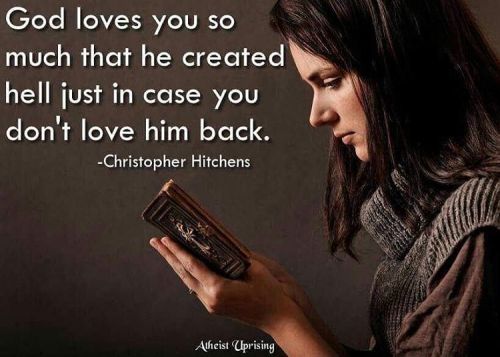
Towards a Defense of Hell


Towards a Defense of Hell[1]

On the Christian view, God is the source (or maybe the "ground"[2]) of all being as well as of beauty, goodness, joy, and love.

Among other things, this means that every existing thing owes its continuing existence to God. It’s not simply that God is responsible for getting existence “going” – as it were. It’s that God also sustains all of existence. He keeps it all going.

This means that it is – metaphysically speaking – impossible for any existing thing to be completely separated from God. The argument is straightforward. If God is the source of existence (or being) then no (contingently) existing thing can exist apart from God. God is the source of being (on the Christian view that we are considering). Therefore, no existing thing can exist apart from God.

What about people who don’t want to have anything to do with God?

People who reject God, insofar as they continue to exist, continue to be “related” (in a broad sense) to the source of existence. But since, as we have said, God is the source of existence, it follows that people who reject God continue to be “related” (in the same broad sense) to God.

What can God do with such people, in order to respect their rejection of Him?

God has two options.

Number one, God could simply stop sustaining such people in existence. However, if an existing thing is entirely cut off from the source and sustenance of existence, then that thing is cut off from existence. But if an existing thing is cut off from existence, then that thing ceases to exist. Since God is the source and sustaining "force" of existence, anything that is entirely cut off from God ceases to exist.

So suppose there were no hell. Suppose, instead, that people who reject God simply ceased to exist. On standard theistic assumptions about God’s power, God is surely able to cease and desist from sustaining in existence those who reject Him. However, would the Christopher Hitchenes of the world be satisfied with this alternative to hell? After all, what is a person saying when he or she declares that he or she wants nothing to do with a God who is the source of existence? Maybe such a person really is saying that he or she does not want to exist at all.

I cannot speak for them, of course. But it seems plausible to think that this would not be well-received. After all, on this alternative, Hitchens might have written instead: “God loves you so much that you’ll cease to exist unless you love him back.”

It seems reasonable to suspect, then, that this would not be looked upon favorably by those who, like Hitchens, purport to impugn God’s fairness, justice, or love by suggesting that there’s something untoward about hell.

But what other choice would God have? It is well to remember that God is (or would be) a necessary being, whereas humans (along with electrons, rocks, galaxies and what have you) are all contingent beings. We could have existed or not existed. No power in heaven or on earth can “promote” a contingent being to a necessary one.[3] No, besides withdrawing his sustaining activity, God has but one alternative.

Number two, God could continue sustaining in existence the person who rejects Him. This is the only other option because God sustains a person in existence and God does not sustain a person in existence are propositions that express logically complementary alternatives.[4]

But it is plausible to think that God’s sustaining activity can be “dialed up,” as it is in the case of heaven – where God’s presence is overwhelming and, so to speak, “in your face”; or God’s sustaining activity can be “dialed down,” as it is in the case of hell – so that God’s presence is as underwhelming and unassertive as metaphysically possible. To put it another way, it seems reasonable to think that God could sustain a person in existence with as minimal a manifestation of His presence as is possible to achieve the sustaining action.

To be somewhat artful, if someone tells God that he or she wants nothing to do with Him, then God seems able to grant that person a kind of bare-bones existence that is as far removed from God’s overwhelming presence as it is possible to get without that person ceasing to exist.

However, recall that, on the Christian view that we are considering, God is not simply the source of existence. He’s not only some kind of cosmic “power cell” apart from which our batteries die. He’s also the wellspring of beauty, goodness, joy, love, and so on.

This implies, though, that if a person is to be as separated from God as is metaphysically possible, then that person is also to be as separated from the source of beauty, goodness, joy and love as is metaphysically possible.

What do we call a “place” of bare-bones existence that is characterized by being as ugly (beauty-less), evil (goodness-less), joyless and loveless as it is metaphysically possible to get without slipping into outright non-existence? The Church calls such a “place” hell, and the Bible variously describes it as a place of anguish, darkness, pain and suffering.

Hell is of course an unfortunate thing. However, hell exists, as someone else once put it, as a complement to human free choice.[5]

For more information, see Michael J. Murray’s article “Heaven and Hell.”[6]


[1] There are doubtless several things that could be meant by the word “defense.” Here, availing myself of basic tenets of Christianity, I propose to sketch an account of what hell is so that the account may serve to show that the doctrine of hell is not indefensible. By the “doctrine of hell,” I mean the view that there exists a “place” of misery, something of an “opposite” to heaven, where go the souls of those who reject God.

[2] Of course, I do not mean to take on board all of the connotations and consequences that Paul Tillich baked into the phrase "ground of being." Here, I mean merely that God is the creator and sustainer of all contingent beings and, therefore, their the "source" of their being / existence.

[3] Think about it. A necessary being is a being for which its non-existence is impossible. A necessary being is a being that never began to exist. Contingent beings, on the other hand, did begin to exist. Some began to exist longer ago than others, and some persist for longer than others. But in any case, a contingent being is a being that, at some time, began to exist. If a contingent being could “become” a necessary being, then it would have to be the case that a being that began to exist in fact is somehow changed so that it never began to exist. But such a change is not only physically impossible (since it implies backward causation), but it is also metaphysically impossible (on standard assumptions about the nature of broadly logical necessity).

[4] To put it another way, the following disjunction exhausts the available alternatives: either an entity is sustained in existence or it isn’t.

[5] Evangelical writer Lee Strobel attributes the following quotation to the Catholic thinker G. K. Chesterton: “Hell is God’s great compliment [sic] to the reality of human freedom and the dignity of human choice,” The Case for Christ, Grand Rapids, Mich.: Zondervan, 2000, p. 235; citing Cliffe Knechtle, Give Me an Answer, Downer’s Grove, Ill.: InterVarsity press, 1986, p. 42. However, in the online edition that I was able to inspect, Knechtle does not provide a source for this quotation. See <https://books.google.com/books?id=gCq6eFcN7FQC&pg=PA42>. It seems to me that hell is not a “compliment” to human freedom – where “compliment” means “a polite expression of praise or admiration.” Rather, hell is better understood as a complement to human freedom – in the sense that is “completes” human freedom. God does not eradicate those who reject Him. He sustains them in existence and thereby “honors” their request to be apart from Him. It’s simply that being apart from God is not at all nice, objectively, since God is the source of all good things.

[6] In Michael J. Murray, ed., Reason for the Hope Within, Grand Rapids, Mich. and Cambridge (U.K.): William B. Eerdmans Publ., 1999, pp. 287-317, <https://books.google.com/books?id=2T-Msjk0OSEC&pg=PA287>.

Image credit: "Atheist Uprising."

Friday, February 12, 2016

Goddess Cults

“Goddesses may have become important symbols to many feminists. …But, warns Cynthia Ozick, ‘Let’s not romanticize them. Their purpose was often human sacrifice. Babies were killed to appease them. Mothers were brainwashed to want their children chosen for death.’” [1]


[1] Quoted by Letty Cottin Pogrebin, “Anti-Semitism in the Women’s Movement,” 1982; Dawn Keetley and John Pettegrew, eds., Public Women, Public Words: A Documentary History of American Feminism, Lanham, Md.: Rowman & Littlefield, 2005, p. 328.

Sunday, January 10, 2016

Heterosexuality, Homosexuality and ‘Bad Faith’? A Response to Terri Murray

Abstract: Matthew Bell defends Jean-Paul Sartre against Terri Murray. Murray’s rebuttal of Sartre is undermined by a failure to distinguish two senses of “cowardice” and “homosexuality.” This leads Murray to misinterpret Sartre. When the terms are carefully disambiguated, Sartre’s point is upheld and shown to apply equally to heterosexuality and homosexuality.

Heterosexuality, Homosexuality and ‘Bad Faith’? A Response to Terri Murray

A Response to Terri Murray’s “Is Homosexuality ‘Bad Faith’?”[1]

Terri Murray gets many things right. Murray correctly notes that “bad faith,” for Jean-Paul Sartre, is the avoidance of responsibility for our actions and choices.

Additionally, as far-reaching as is our freedom to act, it does not range over absolutely everything about us. For example, I cannot choose to be constituted so as to be able to fly. There are some things about my makeup that I simply cannot alter. Murray reports: “These conditions which are not part of our freedom [Sartre] called facticity.”

For some people, their facticity might include elements of a cowardly disposition. Sartre asks us to consider whether a cowardly action, such as running away, can be suitably explained by the declaration, “Well, what did you expect? I’m a coward!” The question is whether the cowardly action can be accounted for by appealing to a cowardly “nature.”

Sartre thinks not. In fact, Sartre denies that human beings have any predetermining “natures.” Therefore, treating cowardly actions as unavoidably issuing from cowardly natures is “bad faith.” To use the contemporary slang for it, it is a cop out.

So far so good. However, Sartre proceeded to compare cowardice to homosexuality, and argued that the homosexual who explained away his homosexual actions as the unavoidable issue of a homosexual nature was displaying just as much bad faith as the coward who ran away.

Murray thinks that Sartre is mistaken in this comparison. For Murray, “[h]omosexuality is a part of some people’s facticity.”

Resisting Sartre’s comparison, Murray suggests a way to argue against Sartre. “Imagine for a moment,” Murray writes, “that instead of drawing the analogy between cowardice and homosexuality, Sartre had instead used cowardice and heterosexuality.” Murray adds that “most heterosexuals do not think of themselves as having any choice about their attraction to the opposite sex”. Murray expands upon this latter point, stating: “I submit that it would be difficult, if not impossible, to find a heterosexual who includes amongst his choices the mere fact of being attracted to the opposite sex.”

Murray wishes us to keep in mind the difficulty – if not the impossibility – of choosing (or, presumably, not choosing) to be “attracted to the opposite sex.” Then we are asked to contrast this difficulty with the “coward’s” difficulty in avoiding cowardly actions. Murray thinks that this juxtaposition is damning because, while we cannot choose our sexual attractions, “[c]owardice …is a choice.”

I’m afraid that it is here that Murray goes off the rails. In fact, the contrast is doubly flawed. Let us agree that homosexual attraction may be part of a given person’s facticity. It does not follow, however, that homosexual actions are likewise to be subsumed under the heading of “facticity.” In fact, to do so is precisely what Sartre labels “bad faith.”

Firstly, the word “homosexual” is ambiguous, that is, it is susceptible to more than one interpretation.

On the one hand, the designation might be applied to persons who have an attraction (whether professed or unprofessed) to persons of the same sex – whether or not this attraction is ever acted upon.

On the other hand, the designation might be applied to persons who actually choose to engage in sexual activities with members of the same sex, whether or not the actions were the expressions of any sort of same-sex attractions (whether latent or patent).

Actually, this cleavage between attraction and action yields four possible combinations. For completeness, I will enumerate them.

Number one, a person could feel a homosexual attraction and also act upon that attraction. Number two, a person could feel a homosexual attraction but not act upon it. Number three, a person could engage in a homosexual act without necessarily feeling any (overt or covert) homosexual attraction. (Think for example of certain, although by no means all, instances of “prison sex,” where the participants are plausibly opportunists without any felt “attraction” to one another – or to anyone of the same sex.) Number four, a person could both fail to experience a homosexual attraction and also refrain from engaging in a homosexual act.

It is important to realize that these four categories do not necessarily distinguish “personality types.” They merely describe the possible ways that instances of attraction can be matched with particular, associated actions.

However, this is just to say that the word “homosexual” is ambiguous. To put it another way, “homosexual” has at least two senses. Let us call one the homosexual-attraction sense, and let us term the other the homosexual-action sense.

Two things should strike the reader. In the first place, not only does homosexuality divide into these two senses, but heterosexuality does as well. To be exact, on this view we have no trouble distinguishing heterosexual attraction from heterosexual action.

One gets for “heterosexuality,” then, a perfect analog of the fourfold taxonomy earlier displayed by “homosexuality.” A person could feel a heterosexual attraction and act upon it. A person could feel a heterosexual attraction, but not act upon it. A person could engage in a heterosexual act without necessarily feeling any (overt or covert) heterosexual attraction. And a person could both fail to experience a heterosexual attraction and also refrain from engaging in a heterosexual act.

In the second place, cowardice seems to divide similarly. Here we also find the second flaw in Murray’s contrast.

Secondly, “being a coward” is arguably also ambiguous. A person can have a “cowardly thought.” For example, in a suitably scary context, I might imagine running away from danger, or I might wish to be someplace else. These “cowardly thoughts” seem sufficiently analogous to having sexual thoughts that I am able to compare feeling “cowardly” with feeling sexual attraction – whether heterosexual or homosexual.

However, these “cowardly thoughts” are surely distinct from cowardly actions. For example, it is one thing to imagine running away from danger, it is another thing to actually, physically run away.

For all we know, “Old Blood and Guts,” United States Army General George S. Patton, might have continually imagined hightailing it out of whatever sticky situation the Third Army and he found themselves. What we know for sure – at least as well as we can know anything about history – is that he did not, in fact, run away. This is to say that he did not display cowardly actions, even if he harbored cowardly feelings. (I am not suggesting that he was plagued by such feelings.)

We see, then, that “cowardice” likewise divides into “cowardly thoughts” and “cowardly actions.”

Given all of this, we can suggest that Murray’s criticism is malformed. Murray follows Sartre in defining “bad faith” in terms of actions and choices, but then unceremoniously slides into talking instead about “attractions” and “orientations.” “Homosexuality” is thus represented only in what I have termed the “homosexual-attraction” sense. Subsequently, Murray contrasts the homosexual-attraction sense against an action sense for being “cowardly.” This runs contrary to the proverbial wisdom that warns against comparing apples with oranges.

Of course, Murray seems correct that, when we consider cowardly actions, we are dealing with choices. However, we need to compare actions to actions and choices to choices. We cannot responsibly compare homosexual attractions to cowardly actions.

The more apt comparison, which also makes for a more charitable reading of Sartre, would be something like the following. Homosexual attractions and cowardly thoughts are similar in that people sometimes misconstrue them as inevitably issuing in homosexual actions or cowardly actions, respectively. To put it another way, there is a misguided temptation to argue that because one has cowardly thoughts, therefore, one must inevitably choose to perform cowardly actions.

This is precisely what Sartre warns against. As Murray recognizes, it is an “attempt to shirk [the] burden of freedom – to misrepresent ‘what we are’ as inevitable, to attribute what we have become to the agency of a secret self, an unconscious self that controls the conscious one.”

We are inveterate free agents. Harboring cowardly thoughts neither excuses nor necessitates the performance of cowardly actions. While a cowardly disposition might be part of my facticity, I remain a free agent. I retain the freedom to choose whether to act according to my cowardly thoughts, or against them.

Construed this way, Sartre’s comparison is not only reasonable, it is also arguably correct. It is entirely understandable that Sartre should warn us against thinking that homosexual attraction must inevitably issue in homosexual action.

This is no one-sided attack upon homosexuality. The consideration generalizes beautifully. There should be no difficulty for an honest heterosexual to endorse a corollary formulation; heterosexual attraction does not inevitably issue in heterosexual action. Regardless of whether my facticity includes a heterosexual or a homosexual orientation, my sexual actions are not determined. I freely choose my actions despite my orientation, whatever it is.

Having a particular sexual “orientation” does not guarantee the performance of any particular sort of sexual action (or even any sexual actions at all) any more than having a “cowardly” disposition compels a person to run away.

This point is made equally well using heterosexuality as the example. Both homosexual attraction and heterosexual attraction are similar to cowardly thoughts in that people sometimes misconstrue these as inevitably issuing in various sexual or cowardly actions. There is no orientation-bias in the application of Sartre’s principle of “no excuses,” properly understood.

Perhaps the Sartrean “moral” is this: There is no inevitability connecting, on the one hand, feelings or thoughts and, on the other hand, actions. Between the two is also and always a free agent.

Murray’s criticism thus appears to melt away, and Sartre is arguably vindicated. It would be bad faith for anyone – heterosexual or homosexual – to abdicate their concrete sexual choices to an abstract sexual “orientation.” We might rightly suspect that such an “orientation” is merely a euphemism for the sort of “nature” that Sartre eschewed.

In the end, things are as Murray relates: “For Sartre, there are no excuses.” While we may not hold sway over our attractions or “orientations,” we always have a choice about whether to act upon, or in accordance with, them or not.

© Matthew Bell 2015

Matthew Bell has a B.A. in theology from William Tyndale College and an M.A. in philosophy from the University of Missouri, St. Louis.


[1] Terri Murray, “Is Homosexuality ‘Bad Faith’?”, Philosophy Now, vol. 39, Dec.-Jan. 2002-2003, pp. 26-27 and online at <https://philosophynow.org/issues/39/Is_Homosexuality_Bad_Faith>.

Tuesday, December 29, 2015

Can Mary's Sinlessness Be Defended?

Here is an argument, mostly directed toward Protestant Christians, in favor of the Catholic doctrine of the sinlessness of Mary.[1]

1. Grace is that by which God applies the Saving power of Jesus's sacrifice. (Scriptural supports include Eph. 2:8, "For by Grace you have been saved..." and Rom. 6:14, "sin will have no dominion over you, since you are ...under Grace.")

2. Mary was "full of Grace" [kecharitomene]. (According to the declaration of the angel Gabriel, as recorded in Lk. 1:28.)

3. Therefore, Mary was full of that by which God applies the Saving power of Jesus's sacrifice. (From 1 and 2.)

4. To be "full" of something is to be unable to accommodate any more of whatever that something is. (This just seems to me to be the primary meaning of the word "full.")

5. Therefore, Mary's being "full of Grace" is for her to have been unable to accommodate any more Grace. (From 2 and 4.)

6. If she had lacked Grace at any time, then she would have been able to accommodate more Grace. (Admittedly, this is the least obvious premise. However, I think that it is plausible. Although, with something like water, a bucket's being full-today does not prevent it's having been empty yesterday, in the case of God's Grace, things are arguably different. God is able to view and consider our lives in toto - from their beginnings. It is reasonable to think that if Mary had lacked Grace at any time, then she wouldn't really have been "full" with it.)

7. Therefore, Mary did not lack grace at any time. (From 5 and 6 by modus tollens.)

8. Therefore, Mary did not lack the the Saving power of Jesus's sacrifice at any time. (By 1 and 7.)

9. If Mary did not, at any time, lack the Saving power of Jesus's sacrifice, then Mary was never separated from God by sin.

10. Therefore, Mary was never separated from God by sin. (From 8 and 9, by modus ponens.)

11. Any person never separated from God by sin is sinless. (From the definition of the "sin.")

12. Therefore, Mary is sinless.

Here is an objection.

If it was requisite that Jesus's parents, God the Father and Mary, be without sin, then it should be requisite that Mary's parents, Joachim and Ann, be without sin.

One way of cashing this out would be as follows. Call this Argument A.

13. If a person, S, is born without sin, then S's parents are sinless.

14. Mary was born without sin.

15. Therefore, Mary's parents were sinless.

There is a confusion, here, rooted in an ambiguity contained in the idea of sinlessness.

On the one hand, someone might think that the Catholic claim is that Mary's freedom from Original Sin was not owed to anything but to her own Good nature. Let us call this the idea that Mary was "necessarily free" from Original Sin.

As far as I can tell, this is not, nor has it ever been, the Catholic claim.

For on the other hand, Catholics answer that Mary's freedom from Original Sin was owed to God's Grace. On this view, the Catholic view, Mary was "contingently free" from Original Sin.

This is no mere verbal jousting. If the claim were indeed that Mary owed God nothing in virtue of her freedom from Original Sin, then the notion that Mary "had no need for a savior" would be obviously true.

On the actual claim, Mary owed her preservation from Original Sin to God. Thus, Mary certainly did need - and had - a savior.

At least one reason to think that Argument A is a failure can be gleaned from this distinction. A person, S, is "necessarily-sinless" if S's sinlessness is essential and could not be otherwise. Moreover, if S *is* necessarily-sinless, then S does not need a savior. If, on the other hand, S is "contingently-sinless," then S's sinlessness could have been otherwise.

Taking these distinctions into account, we could formulate Argument B:

16. If a person, S, is necessarily born without sin, then S's parents are sinless.

17. Jesus was necessarily born without sin.

18. Therefore, Jesus's parents (Mary and God the Father) were sinless.

But Argument B is not extended to Mary. Consider Argument C:

16. If a person, S, is necessarily born without sin, then S's parents are sinless.

19. Mary was necessarily born without sin.

20. Therefore, Mary's parents (Joachim and Ann) were sinless.

Argument C is unsound - by Catholic lights - since premise 7. is false.

It is not the case that "Mary was necessarily born without sin." Mary was contingently born without sin. Her sinlessness was entirely at the Grace and pleasure of God. Jesus's sinlessness was essential. As the Second Person of the Blessed Trinity, his paternity conferred sinlessness to Him. But since, again by Catholic lights, Mary was contingently-sinless, Jesus's maternity also conferred sinlessness to Him.

Hence, Jesus was necessarily-sinless because both of his parents were sinless. His thus being essentially sinless secured His status as savior who did not need saving Himself.

Still, Mary's sinlessness arguably, partially secured Jesus's sinlessness. Although, as has been stated, Mary's sinlessness was neither due to her own nature nor to anything that she had accomplished. Mary was, in other words, saved as the rest of us are: "...by grace ...through faith - and this is not from [herself], it [was] the gift of God - not by works, so that [she cannot] boast". (Ephesians 2:8-9, NIV.)

And, indeed, "boastfulness" is nearly as far from the character of the Virgin Mary as could be conceived. This is why Mary exclaimed: "[M]y spirit rejoices in God my Savior" (Luke 1:47, NIV), and why, henceforth, "all generations will call [Mary] blessed" (Luke 1:48, NIV.)

There is no impropriety in reporting that Mary was saved by God's Grace. It is simply that in her case, the saving Grace was given to her at conception, preserving her from the stain of Original Sin, whereas in our cases, the grace comes after our births.

But there is another objection.

Some Protestants immediately object on the ground that verses such as Romans 3:23 and Romans 5:12 (and so on) imply that Mary sinned.

The problem, here, is straightforward.

21. All [humans] have sinned. (Romans 3:23.)

22. Mary was human. (Self-evident.)

23. Therefore, Mary sinned. (From 21 and 22.)

To see at least one problem with this, consider a parallel argument.

21. All [humans] have sinned. (Romans 3:23.)

24. Jesus was fully human. (From Christian theology.)

25. Therefore, Jesus sinned. (From 9 and 10.)

Obviously, 25. is unacceptable to any Protestant. What can be said about this? What could a Protestant say?

One first-pass reply surely would be for the Protestant to point out that we have good reason, from other Bible passages in the Bible (such as 2 Corinthians 5:21, Hebrews 4:15, etc.) to think that the word "all" in passages like Romans 3:23 (et alia) really does not mean "each and every human without exception."

A principle might be asserted such that: "All" means "each and every, unless we have good Scriptural grounds thinking it does not." In the case of Jesus, the Protestant would surely hold, we have good Scriptural grounds for thinking that it does not.

Actually, this need not be construed as making an "exception." One way to view it is in terms of what philosophers call a "restricted domain." A common example goes like this. If I tell John: "Put all the beer into the refrigerator," I probably should not best be understood as telling John to get all of the beer that there is. Probably, I mean something more like all of the beer that I have in the shopping bags, or all of the beer that there is on my table. The point is, most likely, I am using the quantifier "all" in a restricted sense.

Surely it is plausible to think that Saint Paul is using the word "all" similarly in Romans. On this reading, Paul means (something like) "For all of my readers have sinned."

Of course, we could also hold that Paul did indeed imply an exception. Whereas Protestants may believe that Paul meant "For all have sinned except Jesus," Catholics may hold that Paul meant "For all have sinned except the New Adam [Jesus] and the New Eve [Mary]."

Protestants justify their reading by appealing to Scriptural counter-evidence. Catholics simply believe that, in addition to having good ground to make an exception for Jesus, we also have good reason make an exception for Mary.

This does not place Mary on the "same level" as Jesus. As I argued previously, Jesus's sinlessness was essential to him, whereas Mary's was (on the Catholic view) contingent. Jesus was the savior. Mary was saved by Grace (it's just that she was so saved from the moment of her birth).

Finally, Protestants might say: "Yes, but in Jesus's case, the New Testament is more explicit about this exception; Mary's 'exceptional' status must be inferred."

As far as I can tell, to address this worry, Catholics merely need to do two things. Number one, they need to provide a good reason why the the New Testament is not more explicit about Mary's sinlessness. This does not seem too difficult to do. There appears to be a fairly straightforward reason close at hand. The New Testament is primarily about Jesus (in the Gospels) and about Jesus's Church (from Acts onward). Therefore, we receive the most information in the New Testament regarding Jesus and the Church.

However, as a Catholic, I do not believe that the New Testament is entirely silent about Mary's sinlessness. I believe that the New Testament's clear references to Mary as the "highly favored daughter" who is "full of Grace" and who will, by all future Christians, be called "blessed" are best-explained by the doctrine that Mary was sinless.

This leads to number two, Catholics must provide a good reason to think that Mary was sinless. But this good reason has already been set forth. It can be coherently argued from the Biblical datum of Luke 1:28 that Mary's having been "full of Grace" implies her sinlessness.

In order to rebut this, Protestants must find some fault with the argument that was given in its favor. Short of this, Catholics seem to me to be quite within their rational rights to hold that Mary was indeed sinless, as the Church has believed since ancient times.

Notes:


[1] This argument is not due to me, but has been adapted and expanded by me from David Armstrong, The Catholic Verses, Manchester, N.H.: Sophia Inst. Press, 2004, pp. 181ff.

Surrejoinder to Clayvessel

Continuation of a discussion from Michael Hoffman's weblog, http://revisionistreview.blogspot.com/2015/12/merry-christmas-mary.html

PART ONE OF THREE

Dear Clayvessel, I am, by temperament and by training, used to long and sometimes (even often!) tedious arguments. It’s easy for me to forget that not everyone shares these traits.

My text-length is not an attempt to "win" by attrition. My efforts were primarily and sincerely centered on defending my Catholic belief against your claim that "If [Mary] had no sin, she had no need for a savior."

This concern of yours is simply not a tenet of Catholic Mariology. Nor, I respectfully suggest, is it communicated by any of the 30,102 verses in the Protestant Bible. It is simply based upon the deliverances of the "human reasoning" of various non-Catholics (and, in some circles, it has become something of a non-Catholic tradition).

I am sensitive to the worry that the relevant Catholic doctrine renders Mary such that she wouldn't need a savior. What I have personally come to believe is that Mary's need for a savior is grounded in the contingency of her sinlessness, granted to her at the Grace and pleasure of God - and not the outgrowth of any essentially good nature, as Jesus's sinlessess is.

This resolution is attractive to me because the distinction between contingency and necessity is not ad hoc and because I can find no biblical datum that causes me disquiet. I submit that your interesting (albeit enthymematic) argument that if "it was ...required that [Jesus's] mother be without sin[,] then the same requirement becomes necessary for her mother, and her mother, etc" is effectively blocked with this distinction.

Now you speak of burden of proof. It is not entirely clear to me where the "burden of proof" lies, in this case. But since burden of proof might be thought to attach to positive assertions or predications (i.e., to assertions that say things like "S is f") as opposed to negative assertions (such as "S is not-f"), "Mary is sinless" would indeed need evidence in its support.

One trouble with Catholic-Protestant dialogue is brought into sharp focus, here. What standard of evidence shall we use? Non-Catholics (chiefly, Protestants) either expressly affirm or implicitly adopt an evidential stricture known as "sola scriptura." This "formal principle of the Protestant Reformation" essentially limits allowable evidence to, as you put it, "Scriptural supports." Your request that I "support [my] stance ...with any verses you can find" seems to be an endorsement of sola scriptura.

Catholics do not endorse sola scriptura (at least, not on what is sometimes called its formal reading). Given the idea that positive assertions stand in need of justification, those who explicitly affirm or operationally assume sola scriptura - which asserts that "only Bible verses are allowable evidence" - also bear a burden of proof. What is the argument for sola scriptura?

(End 1/3)

PART TWO OF THREE

It is clear that Catholics have a more expansive set of evidence than do Protestants. Catholics nowhere deny that the Bible is God's Word. But I, for one, do deny that "the Bible is God's Word" is an identity statement. I think that it is a predication. The notion that the definite description "the Bible" and "the Word of God" are coextensive is not anywhere clearly expressed in the aforementioned 30,102 verses.

Is it the case, then, that Catholics and non-Catholics can never have any evidence in common? It depends, in part, on what "Scriptural support" comes to. Let me take a moment to try to get clearer on what that phrase plausibly involves - and does not involve.

On a narrow construal, one might require a "prooftext." As Hoffman has just noted, though, most - but not all - Protestants affirm the doctrine of the Trinity. There is no "prooftext" for this in the narrow sense of some passage that says "God is Triune." But there are certainly "Scriptural supports" in the broader sense of passages that: (a.) do not contradict the notion, and (b.) serve as premises from which the Trinity can be inferred. From this consideration (and others like it), I am impressed that "prooftexting" cannot be relied upon to provide "Scriptural supports" for all the doctrines that Christians affirm to be true.

Hence, I understand "Sciptural support" in a broader sense. For the sake of defending the Catholic belief, I will suggest a "Scriptural support," in a broad sense, for the doctrine of Mary's sinlessness. By "broad sense," I mean that I will state what I take to be biblical truths as premises of an argument, the conclusion of which will be (at least close to) the doctrine of Mary's sinlessness. (This argument is not due to me, but has been adapted and expanded by me from David Armstrong, The Catholic Verses, Manchester, N.H.: Sophia Inst. Press, 2004, pp. 181ff.)

Sketched *very roughly*, a broad defense might look like this.

1. Grace is that by which God applies the Saving power of Jesus's sacrifice. (Scriptural supports include Eph. 2:8, "For by Grace you have been saved..." and Rom. 6:14, "sin will have no dominion over you, since you are ...under Grace.")

2. Mary was "full of Grace" [kecharitomene]. (According to the declaration of the angel Gabriel, as recorded in Lk. 1:28.)

3. Therefore, Mary was full of that by which God applies the Saving power of Jesus's sacrifice. (From 1 and 2.)

4. To be "full" of something is to be unable to accommodate any more of whatever that something is. (This just seems to me to be the primary meaning of the word "full.")

5. Therefore, Mary's being "full of Grace" is for her to have been unable to accommodate any more Grace. (From 2 and 4.)

6. If she had lacked Grace at any time, then she would have been able to accommodate more Grace. (Admittedly, this is the least obvious premise. However, I think that it is plausible. Although, with something like water, a bucket's being full-today does not prevent it's having been empty yesterday, in the case of God's Grace, things are arguably different. God is able to view and consider our lives in toto - from their beginnings. It is reasonable to think that if Mary had lacked Grace at any time, then she wouldn't really have been "full" with it.)

(End 2/3)

PART THREE OF THREE

7. Therefore, Mary did not lack grace at any time. (From 5 and 6 by modus tollens.)

8. Therefore, Mary did not lack the the Saving power of Jesus's sacrifice at any time. (By 1 and 7.)

However, in its basic form, the doctrine of Mary's sinlessness just is the declaration that Mary was saved - by Grace - from the moment of her bith.

I have to add that "Mary sinned" is also a positive assertion and, by this standard, would also place a burden of proof on its asserter. What is your evidence that Mary sinned? Here you have given verses such as those well-known passages in Romans indicating that "all have sinned." (E.g., 3:23 and 5:12.)

The problem, here, is straightforward.

9. All [humans] have sinned. (Romans 3:23.)

10. Jesus was fully human. (From Christian theology.)

11. Therefore, Jesus sinned. (From 9 and 10.)

Obviously, 11. is unacceptable. As you point out, we have good reason - from other Bible passages such as 2 Corinthians 5:21, Hebrews 4:15 and so on - to think that the word "all" in passages like Romans 3:23 (et alia) really does not mean "each and every human without exception."

Catholics simply believe that we have good reason to think that Mary is an exception also. Mary is not on the "same level" as Jesus. As I argued previously, Jesus's sinlessness was essential to him, whereas Mary's was (on the Catholic view) contingent. Jesus was the savior. Mary was saved by Grace (it's just that she was so caved from the moment of her birth).

Why is the New Testament not more explicit about this? I should say that there is a fairly straightforward reason. The New Testament is primarily about Jesus (in the Gospels) and about Jesus's church (from Acts onward). Therefore, we receive the most information in the New Testament regarding Jesus and the Church. However, I am a Catholic because I do not believe that the New Testament is entirely silent about Mary's sinlessness. I believe that the New Testament's clear references to Mary as the "highly favored daughter" who is "full of Grace" and who will, by all future Christians, be called "blessed" are best-explained by the doctrine that Mary was sinless.

Still, for me anyway, no Catholic "convinced" me of this so long as I still believed in sola scriptura. So I understand your hesitation and can only recommend to you that you pray and think about the doctrine of sola scriptura.

All the best to you, Clayvessel.

Sincerely,

Matthew J. Bell

(End 3/3)