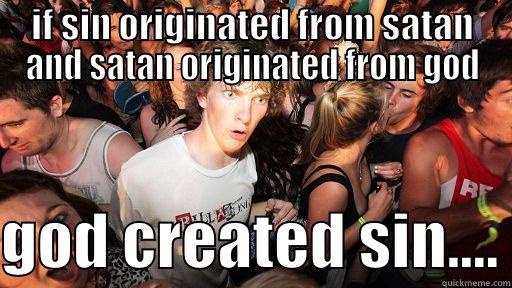
Today’s polemical picture-text is, truthfully, a mess – even by the low standards of internet “memes.”
In this space, I will simply be evaluating the first sentence. The sentence pretends to represent God saying: “I created man and woman with original sin.”
Before I begin to analyze this, I need readers to appreciate a couple of points. Firstly, there is a difference between asserting and arguing. Asserting P would be to simply claim P without giving any argument or evidence in P’s support. Secondly, and more subtly, it is permissible to expose latent problems. But this must be done conscientiously. We might even be able to schematize this, as follows.
The Latent-Problem Principle: It is permissible to criticize a set of propositions, call that set PS, by making explicit some (possibly latent) proposition, call it pn, and then arguing that that (now patent) proposition is (a.) rejectable, and (b.) either necessitates or warrants rejection of PS.
The Latent-Problem Principle
Let’s get the ball rolling by starting with an example that, while in the vicinity, is not quite an example of the Latent Problem Principle (LPP). Suppose that John believes all sorts of things, but among those things he believes.
1. Socrates is immortal.
Maybe he had never thought about it very hard. But he somehow formed that belief. Suppose further that John also believes that:
2. All men are mortal, and
3. Socrates is a man.
Hopefully, with a little effort, you could get John to see that 2 and 3 Together entail:
4. Socrates is mortal.
Once you have established 4, John should readily realize that, either he must reject 1, or he must reject 2 or 3 (or both). And, plausibly, finding that 2 and 3 are more plausible than their negations, he will opt to reject 1 and keep 2-4. This isn’t a case of rejecting an entire set of beliefs. But it is a case of a person’s being made to see how a subset of a his beliefs logically demands the rejection of another of his beliefs.
So far so good?
Example: Hinduism, Brahman and Maya
Now let’s think about a weightier (and possibly more contentious) example, and one that I think is an application instance of the LPP.[1]
Some Hindus believe these things.
5. All things are (despite appearances aspects of) Brahman.
6. Brahman is distinction-less, perfect and pure knowledge.
Some of the same Hindus also seemingly believe:
7. Maya (i.e., illusion) exists.
In fact, Maya is supposedly the explanation for why many people do not recognize 5 as true. However, there is a problem. 5 and 7 together entail:
8. Maya is (an aspect of) Brahman.
But, since Maya is illusion, 8 entails that:
9. Illusion is (an aspect of) Brahman.
Plainly, though, if 9 is true, then it looks like 6 is false. Contrariwise, if 6 is true, then 9 looks false.
Now one could dig in one’s heels and announce that these appearances of contradiction are just further illustrations of Maya! However, if 7 is true, we have another problem. To put it differently:
10. If Maya exists, then it either exists “in” (i.e., as an aspect of) Brahman or Maya exists apart from Brahman.
But we already laid it down that all existing things are (aspects of) Brahman. That’s what premise 5 held. So, since nothing exists apart from Brahman:
11. Maya does not exist apart from Brahman.
But then, we are forced to say:
12. If Maya exists, then it exists “in” (or as an aspect of) Brahman.
Premise 6 claimed that Brahman was distinction-less and also pure knowledge. Illusion, though, is the opposite of “pure knowledge.” So:
13. If illusion exists “in” Brahman, then Brahman is not pure knowledge.
Maybe we can save our model-version of Hinduism by claiming:
14. There is a distinction between Brahman (knowledge) and Maya (illusion).
But if this is true, of course, then Brahman is not distinction-less, again contra premise 6.
We have a problem! Not having a plausible “way out,” we might therefore hold that one or several of these apparent, latent contradictions justifies our rejection of (this version of) Hinduism.[2]
Arguing Versus Asserting
And I think that it does. But, notice that to justify the rejection of (this version of) Hinduism, I had to do some argumentative “leg work.” I did not simply assert that “Hindusim implies a contradiction.” I concluded that it does. There is an important difference between asserting and concluding.
Similarly, I did not simply begin by declaring the contradictories - such as that “Brahman contains a distinction” or “Brahman is not pure knowledge” - of common Hindu notions. I ended by demonstrating that these follow from several (above-stated) common Hindu notions. Again, there is another important difference between declaring and demonstrating.
Starting merely with the assertions and declarations, we would simply have been preaching to the choir of those who already reject (this version of) Hinduism anyway. To put it another way, if I started by saying “Brahman is not pure knowledge,” without any explanation or argumentation, it would be reasonable for a Hindu (or sympathizer) to simply shrug, exclaim “that’s not what I believe!” and merely turn away.
And I think this would be a rational reaction. After all, there are two important possibilities. Number one, it is possible that my statement gets Hinduism wrong – I just made a mistake. If so, then my statement contains nothing at all for the Hindu to worry about. Number two, my statement might have gotten Hinduism right; that is, even though a given Hindu might believe something to the contrary of my statement, it turned out that the Hindu was wrong about her own belief. She was in the position of poor John who just had the wrong belief about Socrates!
The crucial thing, however, is that John was set right by an argument, not by a counter-assertion. The argument is indispensable. Even if I turned out to be correct, the Hindu has no rational obligation to reply to every anti-Hindu counter-assertion that he or she encounters. An argument is, fittingly enough, arguably different. A (well-formed) counter-argument for not-p places a rational obligation on its hearer, because such an argument does not just make an apparently groundless claim that you are wrong if you believe p. It actually purports to show why you are wrong.
Looking Critically at the Picture-Text
Let’s go back and think about the relevant picture-text.
Atheists, non-theists, and anti-Christians of various sorts may well greet the first sentence – “[God] created man and woman with original sin” – with cheers or Facebook “Likes” or whatever. But the Christian would be rational simply to shrug, exclaim “that’s not what I believe,” and scroll elsewhere on her “news feed.”
That this rejection is rational rests on reasons analogous to those given in the hypothetical case of the recalcitrant Hindu. Either the assertion just got the Christian doctrine wrong, and thus can be safely ignored. Or else it happens to give a correct assertion, but without providing the reader with any reason to think that the counter-claim is correct and, therefore, without establishing any basis upon which to begin a logical analysis.
Of course, I am not just any Christian reader. I am actively looking for assertions to rebut and arguments to evaluate. In my case, I am assuming a burden that – rationally – I need not assume.
So my question becomes: Can I construct (or find elsewhere) an argument that actually tries to establish as a conclusion, what the first picture-text simply asserts without argument in its first sentence?
To be exact, can we show that “[God] created man and woman with original sin”?
For readers who may not know, this has to be established via some sort of argument because, firstly, the Bible says something different and, secondly, Christianity has historically taught that sin came into the lives of humankind through the Fall; that is, sin was not inherent to Adam or Eve when God created them.
What Does the Bible Say?
Just for reference purposes, we will look at (some of) what the Bible says. I should state, up front, that in what follows I will be assuming what is called an “Anselmian view of God.”[3] On this view, God is a being “than which nothing greater can be conceived.”[4] Our first passage is taken from the Book of Genesis, chapter 1.
“Then God said, ‘Let us make mankind in our image, in our likeness, so that they may rule over the fish in the sea and the birds in the sky, over the livestock and all the wild animals, and over all the creatures that move along the ground.’ So God created mankind in his own image, in the image of God he created them; male and female he created them. God blessed them… God saw all that he had made, and it was very good.”[5]
This passage indicates a couple of things.
Number one: Humans were created in the “image of God.”[6] However, God is that than which nothing greater can be conceived. If, as is both plausible and historical (in the Christian tradition), being loving (or being good) is conceived of as a perfection, then God must be loving (or good). How loving (or good) must God be? Think of a being and call it “Being1.” Now make Being1 loving (or good) to some degree or other. Ask: Is it possible for another being, say Being2, to be more loving (or better, morally) than Being1? If it is possible, then Being1 is not God. If it’s not possible, then theologians would say that Being1 is as loving (or as good) as it is possible to be. To put it differently, Being1 would be all-loving (or all-good).[7]
Thus we are in a position to see that the Christian view is that God is all-loving (or all-good). To say that God is all-loving (all-good) is to say God that God has no moral imperfection. But sin is a moral imperfection. Therefore, to say that God is all-loving (all-good) is to say that God is not sinful.
But if the image of God inheres in humans, that is, if humans were, in some sense, fashioned in the “image of God,” then it appears that this “image” is not inherently sinful.
Furthermore, the Genesis passage just surveyed has God declare, after creating (what appears to be) the universe, plants, and animals – including, finally, humankind – that “all” – that is, all of the universe, plants, and animals just canvassed – “that he had made …was very good.” But sin is not “very good.” Therefore, sin was not part of “all that [God] had made,” restricting ourselves to everything recorded in Genesis. To be more exact, of everything that Genesis records God having made, of all of that God says: “it was very good.” Therefore, sin was not part of the all of that which Genesis records God having made.
What I AM and Am NOT Doing
Please understand, dear reader, what I am – and am not – trying to do, here. I am not (presently, at any rate) trying to convince the atheist, non-theist, or anti-Christian that the Genesaic portrayal of events is correct or veridical. I am simply trying to establish that, from the Genesaic account (which, of course, Christians take seriously – if not literally), it is reasonable to conclude that God did not create humans in a state of sinfulness.
This is plausible from the conjunction of Genesis 1 and the historic view about what we mean by the word “God”: that is, a being than which nothing greater can be conceived.
But if God did not create humans in a state of sin, whence came sin?
Let’s again turn to the Bible. In Genesis chapters 2 (verses 7-8, 16-18, and 22) and 3 (vv. 1-6, 11b-14) we read:
“Then the Lord God formed a man from the dust of the ground and breathed into his nostrils the breath of life, and the man became a living being. Now the Lord God had planted a garden in the east, in Eden; and there he put the man he had formed. …And the Lord God commanded the man, ‘You are free to eat from any tree in the garden; but you must not eat from the tree of the knowledge of good and evil, for when you eat from it you will certainly die.’ The Lord God said, ‘It is not good for the man to be alone. I will make a helper suitable for him.’ …Then the Lord God made a woman from [a] rib he had taken out of the man, and he brought her to the man.
“Now the serpent was more crafty than any of the wild animals the Lord God had made. He said to the woman, ‘Did God really say, You must not eat from any tree in the garden?’ The woman said to the serpent, ‘We may eat fruit from the trees in the garden, but God did say, You must not eat fruit from the tree that is in the middle of the garden, and you must not touch it, or you will die.’ ‘You will not certainly die,’ the serpent said to the woman. ‘For God knows that when you eat from it your eyes will be opened, and you will be like God, knowing good and evil.’ When the woman saw that the fruit of the tree was good for food and pleasing to the eye, and also desirable for gaining wisdom, she took some and ate it. She also gave some to her husband, who was with her, and he ate it. …
“[God asked:] ‘Have you eaten from the tree that I commanded you not to eat from?’ The man said, The woman you put here with me—she gave me some fruit from the tree, and I ate it.’ Then the Lord God said to the woman, ‘What is this you have done?’ The woman said, ‘The serpent deceived me, and I ate.’ So the Lord God [cursed] the serpent… [and the woman and the man].”
Again, it is no part of my present task to demonstrate that the account is veridical. Nor is it any part of my project, here, to adjudicate between those who debate whether the account is literal, metaphorical, or something else.
Rather, I am simply arguing that, if we take the account seriously – as Christians do – it appears that sinfulness entered the human “sphere” through the choices of the first man and woman, giving in to the temptations of the serpent. These are simply summaries of what the account says. If one is to press the idea that “God created sin,” then one has to argue for that idea. It does not come from a prima-facie reading of the Genesis account.
The First Picture-Text Has No Argument
However, maybe it is possible to construct such an argument. After all, that Brahman is distinction-riddled and imperfect in knowledge does not come from a prima-facie reading of Sankara. These came from arguments that, on Hindu assumptions together with the laws of logic, we seem impelled to admit these things about Brahman.
Maybe the atheist, non-theist, or anti-Christian can come up with an argument that shows, contrary to the Genesaic account and historic Christian theology, God is, in fact, the creator of sin.
But, plainly, no such argument is found in today’s polemical picture-text.
I would be rational to simply leave things here to rest. But as I said I am looking for interesting lines of inquiry to probe. And this is an interesting line of inquiry. So let me go on.
Looking for an Argument Elsewhere
For there is another picture-text that does submit a candidate for the argument that is missing in the first picture-text.
Now it is needful that I modify the argument slightly since, in the posted form, the argument is invalid. To be more precise, the argument moves from talking about “origination” to talking about “creation.” Nothing follows from this unless one assumes that “origination” and “creation” are synonymous in the present context. However, two possible changes are easily enough proposed. We could change all occurrences of “originate” to “create” or we could change all occurrences of “create” to “originate.” Let’s go with the latter change.[8]
15. If sin originated from Satan, and Satan originated from God, then sin originated from God.
16. Sin originated from Satan and Satan originated from God.
17. Therefore, sin originated from God.
This argument is deductively valid. That is to say, if the premises are true (and they may not be), then the conclusion must be true also.
To avoid the conclusion, then, I must identify at least one problem with the argument’s premises. In fact, I suggest that the premises have two relevant problems – either of which, if successful, is sufficient by itself to avoid the conclusion.
Two Objections to the Argument
PROBLEM 1: On Equivocation
It’s not clear that sin did “originate from Satan.” To get at this problem, let me ask a question that I had postponed: why does “Satan created sin” sound peculiar, if “originate” and “create” are, in this context, supposed to be synonymous?
I will suggest an answer. I suggest that we reserve the word “creates” for things that have real being – things that have “positive existence,” if you like. St. Augustine famously argued that evil was, strictly speaking, not a thing. He argued that evil had no positive existence. It was, rather, a privation, that is, an absence or lack, of good.
Does this mean that “there is no such thing as evil”? It depends on how seriously we are using the word “thing”! On this view, evil is not a concrete “thing” like rocks or trees are things. It’s not even an abstract “thing” as is justice or beauty. Rather, evil is a lack of good. To say that something is “evil,” then, means that that thing (whether concrete or abstract) is not as good as it could or should be.
We could say that many propositions of the form “x is not as good as it should be” are true. Thus, although evil is not a “thing,” still, it is true that some bona fide things – e.g., actions – are not as good as they should be. Indeed, some such actions – e.g., murder and rape – are not good at all.
So “murder” is something like the name for a really existing action, like stabbing someone to death, that is such that being good is not one of its properties.[9] So whereas “evil” has no positive existence, what does exist, unfortunately, is an array of actions that do not have goodness among its properties.
Perhaps an analogy or two would be helpful.
Do Holes Exist?
Think of a wall. Maybe it’s made of stone. Stone appears to have positive existence. Physicists tell us that it’s made of atoms and molecules and so forth. Now think of a hole in the wall. Question: Do holes have positive existence? If we listed off everything that existed, would we have to list “holes” along with “rocks” and “trees” and so on? What would holes be “made of”?
Plausibly, the answer is no. Holes are not “made of” anything. We can think of the hole in the wall as simply a place where there is no stone. Hence, saying “there is a hole in the stone wall, here” is just another way of saying “here is a place where the (otherwise) stone wall does not have a stone.”[10]
Of course, if any otherwise stone wall lacks a stone in a particular place, we might well say “the wall has a hole, here.” The sentence is true just in case “there is not stone, here” is true and we would expect or require “there is a stone, here” to be true.
Or again, think of a room full of light. Light is something. Physicists tell us that light is made of photons. Now imagine turning off the light so that the room is dark. Is there such a thing as darkness? Does the act of turning off the light somehow prompt stuff called “darkness” to spill in, filling up the space? If so, what is darkness “made of”?
Again, it is plausible to think that darkness isn’t “made of” anything (i.e., any thing). Saying “the room is dark” is simply another way of saying “the room doesn’t have any light.”
Similarly with our account of holes, various propositions such as “this room is dark” will have analyses that are true: for instance, “this room has no light” (if and when it doesn’t).
Perhaps now we should define “sin.” I have done this elsewhere, so I will simply summarize.
“Sin” is “purposely (willfully) doing something that you know is evil (or bad), or purposely not doing something that is an obligatory good.”
What does this mean, if “evil” is a privation? It means that to sin is to act in such a way that one’s action lacks some good that it ought to have. Does this mean that there is no such “thing” as sin?
As before, there is no such “thing” as evil. If we say “murder is evil,” we mean “murder is not good.” And there certainly, and unfortunately, are acts of which it is true to say “these acts are not good.” Murder is one; rape is another. Etc.
Moreover, there are actions (that is, in the Kantian idiom, acts that have been performed by some actors) of which it is true to say of them “these actions are not loving.” If we say, “Cain’s murder of Abel was sinful,” we mean “Cain’s murder of Abel was not loving.”
Back to the Second Picture-Text
It may be that the reason “Satan creates sin” sounds false (to my ears, anyway), is because “creates” is reserved for things that have positive existence.
On the Augustinian interpretation, “Satan originated sin” cashes out to (something like) “Satan was the first free agent who made a choice that lacked goodness.”
Nothing with positive existence was brought into being.
Hence, the sentence “Satan creates sin” – if we tolerate the nonstandard use of the verb – does not use the word “creates” in the same sense as it is used in the sentence “God created Satan.”
On the Christian view, it is commonly held that the being called “Satan” (or, the adversary) was created as an angel – sometimes identified with Lucifer. In any case, what God created was an angel, and angels (on the Christian view) have positive existence.[11]
This suggests that there are two sorts of creation/origination (CO). As a first pass, I will call the first Literal-CO, that is, creation/origination of some thing, with positive existence. I will call the second Non-Literal-CO, that is, any other tolerable use of “creation” or “origination” where there is no actual, positively existing thing that results.
Equivocation
With this groundwork laid, I suggest that the first problem with the argument is that, regardless of which word (“creates” or “originates”) we select, we run into the fallacy of equivocation. “Equivocation” occurs when a word is used in two or more places in the same linguistic context, but has a different meaning in one or more of those places.
For instance, suppose that I say: Herbert Palmer created Vera Jayne Palmer, and Vera Jayne Palmer created a problem for my marriage. If I conclude that, therefore, Herbert Palmer created a problem for my marriage, I seem clearly to have used “created” in differing senses. Herbert Palmer “created” his daughter in the sense of fathering her. If Vera Jayne Palmer created a problem for my marriage, it was in the sense that I had difficulties keeping my eyes off Jayne Mansfield. Those of not the same senses of “created.”
In the case of the picture-text, the argument advanced depends upon “creation”/“origination” being used univocally, that is, in the same sense throughout. This is to say that, “If sin originated from (or was created by) Satan, and Satan originated from (or was created by) God, then sin originated from (or was created by) God,” requires that we’re not talking about different senses of “creation” / “origination.” But we are talking about different sorts of “creation” / “origination.”
“Sin originated from Satan” only in a non-literal sense. Satan “originated” or “created” sin only the sense that the missile “created” a hole in the wall. We speak like this all the time. But we do not appear to be committed to the positive existence of “holes.” Rather, what we mean is that the missile destroyed part of the wall. The missile did not bring something, a “hole,” into existence that wasn’t there before. On the contrary, the missile took something (say a subset of stones) out of existence that had previously existed.
I suggest that this is what Satan did as well. Satan did not bring something, “sin,” into existence. He did not, so to speak, add “evil” to an action or choice. Rather, what he did was to subtract some good.
But if this is correct, then the argument equivocates on the words “creates” and “originates” – whichever word one chooses to insert. This can be labeled, as follows.
15’. If sin Literally-Originated from (or was Literally-Created by) Satan, and Satan Literally-Originated from (or was Literally-Created by) God, then sin Literally-Originated from (or was Literally-Created by) God.
16’. Satan Literally-Originated from (or was Literally-Created by) God, but sin only Non-Literally-Originated from (or was Non-Literally-Created by) Satan.
Thus, the argument fails. In fact, I think that there is another equivocation problem in the vicinity. I will get into that further on.
PROBLEM 2: On Transitvity
But suppose that the reader is not persuaded by the considerations advanced under the heading “PROBLEM 1.” Maybe the reader thinks that the Augustinian approach is suspect, or that I have mis-applied it in the present case. Perhaps the reader thinks that he or she has discovered a potential, univocal reading that saves the argument.
Let us assume that something like this is the case. Assume that everything that I wrote in the previous section was wrong. Pretend that there is a univocal reading available. Still, I have another objection.
Even with a univocal-reading, the argument crucially depends upon “creation” / “origination” possessing the logical property known as transitivity. Here is a dictionary definition for the adjective “transitive”: “Of or relating to a binary relation such that, whenever one element is related to a second element and the second element is related to a third element, then the first element is also related to the third element. Examples of transitive relations are ‘less than’ for real numbers (a < b and b < c implies a < c) and divisibility for integers (a divides b and b divides c mean that a divides c).”[12]
An easy illustration of transitivity is the “equal to” or identity relation. If x = y, and y = z, then it follows as a mathematical consequence that x = z.
Or think about being taller than. If John is taller than Joe, and Joe is taller than Steve, then it follows – as a logical consequence - that John is taller than Steve.
Intransitivity, Non-Transitivity & Other Matters
However, not all relations are transitive. Some relations are intransitive. An intransitive relation is one for which, if P is related to Q, and Q is, by the same relation, related to R, then it follows as a logical consequence that P is not (by the same relation) related to R.
For example, consider being the mother of. If Jane is the mother of Sarah, and Sarah is the mother of Rebecca, it follows as a logical consequence that Jane is not the mother of Rebecca.
How about being the immediate successor of? If George VI is the immediate successor of Edward VIII, and Elizabeth II is the immediate successor of George VI, then Elizabeth II was not the immediate successor of Edward VIII.
It turns that there are also relations that are neither transitive nor intransitive. These relations are termed non-transitive. This sort of relation is helpfully illustrated by Darren Brierton. He writes:
“…[L]ikes is a non-transitive relation: If John likes Bill, and Bill likes Fred, there is no logical consequence [one way or the other] concerning John liking Fred.”[13]
The moral, then, is that we may not assume that just any relation will be transitive.
Is “Creation” Transitive?
The crucial question obviously is: Is “creation” / “origination” transitive? Note, first, that it has to be transitive for the argument to succeed. If “creation” / “origination” is either in- or non-transitive, then the argument fails. Let us see.
Our task is to try to come up with uncontroversial examples, using “creation” / “origination,” that show whether the relation is usually transitive or intransitive or neither. As (presumably) competent and native English-speakers, we need to check for transitivity using our linguistic intuitions.
If Samuel Ogden Edison, Jr. originated Thomas Edison, and Thomas Edison originated the light bulb, does it follow that Samuel Ogden Edison, Jr. originated the light bulb?
Or if Lionel Dahmer created Jeffrey Dahmer, and Jeffrey Dahmer created chaos, does it follow that Lionel Dahmer created chaos?[14]
It seems that, if these conclusions do follow, then the same reasoning could be rolled backwards almost indefinitely. We would then be in the position of ascribing the light bulb to Edison’s progenitors, his supposed evolutionary forebears, or God himself. Likewise, we would have to ascribe Jeffrey Dahmer’s “chaos” to his entire family, some random pre-Homo Sapien Hynerpeton (on one view of evolutionary history, anyway), or to the Big Bang itself.
What Do We Make of This?
Let’s consider a couple of other examples. What if I say: Alexandre Dumas (père) created Edmond Dantès, and Edmond Dantès created a plan to get revenge on Danglars, Mondego, and Villefort? Shall I say that Dumas created a plan to get revenge on Danglars, Mondego, and Villefort?
I think that this is plausible. After all, Edmond Dantès is fiction created by Dumas. Dumas is the agent; in reality, Dantès does nothing.
Or how about this? I create a robot and the robot creates a sandwich. Do I create the sandwich?
I want to be careful, here. Earlier I alerted the reader to a second possible equivocation in the vicinity of the first (as I alleged previously). Although I am setting the Literal/Non-Literal business aside, in this section, I am now in a position to examine the second (possible) equivocation.
Perhaps the most direct route for getting at this is by way of the philosophical position known as agency theory.[15] Very roughly, an Agent is an entity – something like an Aristotelian substance – that can initiate causal chains that are not determined by prior efficient causes.
Compatibilism & Libertarianism
“For the compatibilist, the person, insofar as he or she is an agent, is simply a series of events through which a causal chain passes on its way to producing an effect, say, one’s hand going up. As long as this effect is caused by the right things in the right way (e.g., the character states of the agent), the act counts as free. …[For the Libertarian, p]ersons are agents and, as such, in free acts they either cause their acts for the sake of reasons (called agent causation) or their acts are simply uncaused events they spontaneously do by exercising their powers for the sake of reasons (called a noncausal theory of agency).”[16]
What is the point of all this? There are (at least) two additional senses for “creation” / “origination,” each springing from different, overarching (or underlying!) conceptions of the relationship between free will and determinism.
Call the Libertarian version of “creation” / “origination” A-rigination, and call the Compatibilistic version C-rigination. To keep the model simple, let’s say that “A-rigination” is the initiation of a brand new causal chain that, while it may (and should) be directed by final causes (or reasons), is not determined by efficient causes. On the other hand, let’s say that “C-rigination” is merely the arbitrary identification of part of an efficient causal chain, all of which is entirely determined by whatever initiated the chain.
Do these distinctions explain my differing intuitions about the cases of transitivity and intransitivity canvassed above? Here’s a review.
If Samuel Ogden Edison, Jr. originated Thomas Edison, and Thomas Edison originated the light bulb, does it follow that Samuel Ogden Edison, Jr. originated the light bulb? It depends. Was Thomas Edison Libertarian free in creating the light bulb? If he was, then we have the following. If Samuel Ogden Edison, Jr. originated [no matter how] Thomas Edison, and Thomas Edison A-riginated the light bulb, does it follow that Samuel Ogden Edison, Jr. originated the light bulb? No. Regardless of whether Samuel A-riginated or C-riginated Thomas, the fact (if it be such) that Thomas A-riginated the light bulb means that Thomas initiated a brand new causal chain in virtue of that action.[17]
Suppose, instead, that the Libertarian view of free will is false and that Compatibilism is true. In that case, we would get this. Since Samuel Ogden Edison, Jr. C-riginated Thomas Edison, and Thomas Edison C-riginated the light bulb, it follows that Samuel Ogden Edison, Jr. C-riginated the light bulb. Of course, since C-rigination is merely the arbitrary identification of part of a causal chain, if Compatibilism is true it would be equally true to say that Edison’s great-great-great-great-great grandmother C-riginated the light bulb, or that the Biblical Adam C-riginated it, or that some unspecifiable single-celled organism from the pre-Cambrian period did so.
Since my intuitions track more closely along with the first reading, I take it that I have linguistic evidence that Compatibilism is false. But, regardless, the point is that whether we say that “originated” is transitive or not depends on what sort of account we give for free will.
This seems to generalize. Consider, again, the case of Jeffrey Dahmer. If Libertarianism is true, and if Jeffrey Dahmer acted freely, then the fact that Lionel Dahmer created Jeffrey Dahmer, and Jeffrey Dahmer created chaos, does not entail that Lionel Dahmer created chaos, because Jeffrey Dahmer initiated causal chains on his own and he is, on his own, responsible for them. On the other hand, if Compatibilism is true, then we might as well say that the Big Bang created the relevant “chaos.” Jeffrey Dahmer was merely a cog in the cosmic wheel.
The Fictional Wrinkle
Or how about these? Alexandre Dumas (père) created Edmond Dantès, and Edmond Dantès created a plan to get revenge on Danglars, Mondego, and Villefort. Did Dumas create a plan to get revenge on Danglars, Mondego, and Villefort? As I said previously, clearly, Edmond Dantès is a fictional character created by Dumas. Even if Libertarianism is true, Dumas is the only actual agent. Therefore, it might seem that Dumas did create a plan to get revenge. But there seems to be something wrong.
Did Dumas create an actual plan to get actual revenge on actual individuals? No. He created a fictional plan to get fictional revenge on fictional characters. Notice the difference in the word “create.” Did Dantès “create” in the same sense as Dumas? No. Dumas actually created a story; Dantès has no actual existence, and therefore cannot actually create anything.
We could plausibly say that even if Libertarianism is true: Dumas A-riginated Edmond Dantès. But, being fictional, Edmond Dantès was merely a figment of Dumas’s imagination. Suppose we want to say that Dantès C-riginated the plan to get revenge on Danglars, Mondego, and Villefort, and that Dantès was an instrument used by Dumas – a literary contrivance that Dumas, as the author, used to tell his story. We might be tempted to say therefore that “Dumas created a plan to get revenge” is true. After all, the entire story – including the revenge plot – owes to Dumas.
The problem is that the reasoning used to generate the conclusion “Dumas created a plan to get revenge” violates the rules of transitivity. Transitivity holds when three things (a, b, and c) are all related by the selfsame relation. Then, if the relation is transitive, we can say that: If aRb and bRc, then aRc.
However, in the Dumas case, the relevant three things are not related by the selfsame relation. For we said that Dumas A-riginated Edmond Dantès and that Dantès C-riginated the revenge plot. A-rigination and C-rigination are not the same relation. Therefore, nothing follows by transitivity.
Of course, Dumas is the author of the entire story. So we want to ensure that he gets credit for everything that happens. We secure this outcome, and make things univocal, by substituting for “creates” a word like “pretends.” Then we would say something like this: Dumas pretends that Dantès exists and Dumas pretends that Dantès plots revenge.
Things go similarly with my robot, but not identically. Assuming Libertarianism, if I A-riginate a robot, then – unless the robot somehow becomes a self-aware, artificially intelligent being like 2001: A Space Odyssey’s Hal, then the robot merely C-riginates the sandwich. The robot did not decide to create a sandwich in the sense that it initiated a new causal chain. Here it seems plausible to say that I created the sandwich by means of the robot. The robot was my instrument.
But, like the Dumas case, we do not attribute the sandwich-making to me because of transitivity. Nothing follows by transitivity since A-rigination and C-rigination pick out two different relations. Rather, the whole example now seems misstated. Instead of saying I created a robot and the robot created a sandwich, I should have instead said I created a sandwich by means of a robot.
Applying It All to the Case at Hand
The takeaway might be this. If Libertarianism is true, and if sin A-riginated from Satan, then sin did not A-riginate from God even if Satan did A-riginate from God. To put it another way, even when the terms are univocal – notice that A-riginate is used throughout – God cannot be blamed for sin if that sin was Satan’s (Libertarian-)free choice. Satan would have initiated a brand new causal chain – one that was independent of the causal chain, initiated by God, that A-riginated Satan himself.
But suppose we substitute C-rigination. Then we get this: Sin C-riginated from Satan, but Satan A-riginated from God. Can we conclude that “sin A-riginated from God”? We cannot depend upon transitivity to carry this conclusion. Remember that transitivity only applies when we have three things related by the selfsame relation. But if Satan C-riginated sin and God A-riginated Satan, then, because A-rigination and C-rigination are different relations, nothing follows by transitivity alone.
Conservatively, I would suggest that this shows "origination" is non-transitive - since it can mean either A-rigintion which appears to be intransitive, or C-rigination which appears to be transitive.
We are faced with three options.
NUMBER ONE:
We could affirm either Libertarianism or Compatibilism and hold that God’s A-rigination of Satan is like Dumas’s A-rigination of Dantès. In this case, it is true that God is the author of everything. But we would seem to be compelled to have to say that everything Satan does is on a par with Dumas’s fiction. To put it differently, God pretends that Satan exists and pretends that sin exists, and so on. This doesn’t seem correct. For one thing, it seems to reduce sin to a fiction. And that’s something that I’d wager even the author of the picture-text wouldn’t want to do. After all, doesn’t an artist have creative freedom? On what objective basis could God be criticized for pretending that sin exists?
NUMBER TWO:
We could affirm Compatibilism and simply lay it down that God is the only free agent. However, this would seem to force us to say that “Satan originated sin” is misstated and should instead be “God originated sin by means of Satan.” This is the conclusion that the authors of the two picture-texts seem to want. Sure, right: If God is the only free agent, then everything – the good and bad – must owe to God. But why think that God is the only free agent? We have been given no reason to accept this. It is arguable, therefore, that the (implicit) argument begs the question against Libertarianism. Of course, this is our third option.
NUMBER THREE: We could affirm Libertarianism, use A-rigination univocally throughout the argument, and admit that God is not to blame for Satan’s new causal chain.
It is crucial to notice that nowhere on either of the two picture-texts do we have anything even remotely approaching either an argument for Compatibilism or an argument against Libertarianism.
If this argument shows that God is the “creator” of sin, then we seem impelled to say that it only does so by assuming a contentious and eminently reject-able view about free will.
Brief Summary & Concluding Remarks
As far as I can tell, this argument only plausibly suggests that God is the “creator” of sin if all the following are the case:
- “Creation” / “origination” have a univocal sense that works throughout the argument;
- “Creation” / “origination” are transitive;
- Augustine’s view of evil is false;
- Libertarianism is false; and
- Compatibilism is true.
However, quite obviously, none of these has even been attempted – let alone accomplished or established.
Moreover, by my lights: “creation” / “origination” are equivocal; “creation” / “origination” are non-transitive; St. Augustine's view of evil is defensible, compelling, and possibly true; Libertarianism is defensible, compelling, and possibly true; and Compatibilism, while defensible, is less-compelling and arguably false.
So the first line of the first picture-text is merely an unargued assertion resting upon a highly questionable resolution to the metaphysical problem of free will. And it’s passed off as if it were an uncontroversial tenet of Christianity. The picture-text gets worse from there! But I am out of time for today.
Notes:
[1] What follows is my much-condensed adaptation of Robin Collins’s evaluation of Sankara’s version of Hinduism, as found in “Eastern Religions,” Michael J. Murray, Reason for the Hope Within, Grand Rapids, Mich. and Cambridge [U.K.]: William B. Eerdmans, 1999, pp. 182ff, esp. p. 189. Any errors are doubtless my own.
[2] I am merely illustrating something, here. I am not pretending to have made irrelevant all other philosophical debate over the truth or falsity of Hinduism.
[3] Briefly, on this view, God possesses all of the “perfections” or “great-making properties.” These properties may be defined as “those properties, with intrinsic maxima, that it is inherently better to have than to lack.” For example, it is inherently better to have knowledge than to lack it. Therefore, God would have to have knowledge. But knowledge also (plausibly) has an intrinsic maximal value: namely, knowing, of all true, actualized propositions that they are true, and knowing of all false propositions that they are false. (We might also add: knowing the truth-values of all counterfactual and otherwise possible, but non-actual propositions. But I will leave this aside, presently.)
[4] In Latin: Aliquid quo nihil maius cogitari possit.
[5] Genesis 1:26-28 and 31, New International Version.
[6] In Latin: Imago dei.
[7] I.e., Omnibenevloent.
[8] This seems the charitable thing to do. After all, it is not at all clear that “Satan created sin” is true. It seems to me clearly false. But the “originate”-reading does not sound as obviously false (though it still may be). So I will go with that.
[9] To put it slightly differently, “murder is evil,” is something like an abbreviation for a string of propositions (e.g., “S stabbed T to death,” “S shot and killed T,” and so on) none of which could be prefixed by the predication “it is good that.”
[10] This works for holes of all sorts. “There is a hole in the dirt, here” is just another way of saying that “here is a place where there is no dirt,” and so on.
[11] Of course, in this case we have an angel who, after making a free choice bereft of goodness, fell from his lofty position and became the Adversary.
[12] “Transitive,” American Heritage Dictionary of the English Language, 5th Ed., Boston: Houghton Mifflin Harcourt Publ., 2016, <http://www.thefreedictionary.com/transitivity>.
[13] Darren Brierton, “Objects, Properties and Relations,” Philosophy Vade Mecum, Univ. of Missouri – Kansas City, <https://cas.umkc.edu/philosophy/vade-mecum/2-3.htm>.
[14] Recall that the burden of the previous section was to show that nouns like “chaos” have no positive existence. However, also recall that I began the present section on the assumption that everything I wrote previously was wrong. If the reader has the sense – as indeed I do – that “creating chaos” and “creating Jeffrey Dahmer” involve two different senses “creating,” then I invite him or her to revisit the preceding text. I think that the same problem plagues premise 16.
[15] This is, of course, embedded in a tangled thicket surrounding the problem of free will. There are numerous views. On one pole, some people endorse “Hard Determinism.” This is the view that “choice,” strictly speaking, does not exist. In its “Scientific Version,” all things are held to be absolutely predetermined by the laws of the universe together with the initial conditions. In a “Theological Version,” Divine “predestination” would also play a role. God is the only free actor. Going a bit farther, “Fatalism” is the view that the laws and conditions themselves could not have been otherwise. Fate implies a thoroughgoing determinism on “all metaphysical levels.” In any event, determinists can be of “Hard” or “Soft” varieties. The “Hard Determinist” thinks that “freedom” and “determinism” are incompatible; there is, in fact, no such thing as “free will.”
A somewhat middle of the road position is “Soft Determinism” or “Compatibilism.” “Compatibilism” designates the idea that “freedom” is compatible with “determinism” after all. Confusingly, Compatibilism also comes in “Hard” and “Soft” varieties. The “Hard Compatibilist” holds that “freedom” requires determinism. Roughly, this is because a choice without a sufficient, efficient cause is thought to be utterly random. At the other extreme from determinism, some endorse “Simple Indeterminism.” This is the view that nothing is determined.
On the other hand, others are “Soft Compatibilists,” who hold instead that free choice does not require determinism, but is compatible with it. So the Soft Compatibilists want to try to preserve free will and determinism. Some “Soft Compatibilists” (called “Passive Self-determinists” or “Classical Compatibilists”) tend
to hold that a person is free just in case she can act according to her strongest inclination. “Compatibilism claims that every person chooses according to his or her greatest desire. In other words, people will always choose what they want – and what they want is determined by (and consistent with) their moral nature. Man freely makes choices, but those choices are determined by the condition of his heart and mind (i.e. his moral nature),” “Compatibilism,” Theopedia, <http://www.theopedia.com/compatibilism>.
In theological contexts, Calvinists tend to be Compatibilists of this sort. While the inclination (i.e., desire) determines the “choice,” still, a person can count as “free” on this view if she isn’t hindered from acting on her inclination. “Compatibilists argue that if all of our choices are uncaused, they would then be completely arbitrary, unpredictable, and not really moral actions at all,” ibid.
“Incompatibilism” is the view that freedom simply cannot be determined – strictly so-called – in any sense. One form of Incompatibilism, called “Libertarianism” (in a non-political sense), holds that for a person to be free with respect to some action, A, is for that person to be able to do A or not do A – regardless of “inclination” or “desire.” In other words, Libertarians hold that it is possible for a person to act against her inclinations and desires. Against the Compatibilist, Libertarians contend that while our actions and choices are “uncaused” in the sense that they lack antecedent, efficient causes, they are not altogether “uncaused” because our (rational) actions and choices have final causes, that is, reasons. (Recall that Aristotle enumerated four different “causes”: Material, Formal, Efficient, and Final.)
In the vicinity is another Incompatibilistic view called “Agent Theory” or “Action Theory” which holds, roughly, that determinism applies to events, but denies that “choices” and “actions” are events in the relevant sense. On this view, Agents (something like “conscious beings”) can initiate new causal chains and perform Actions (also termed “Happenings” – something like “events,” but importantly different in that they are not just strings of efficient causes) that are not mechanically determined by events.
For more, see Milton D. Hunnex, Chronological and Thematic Charts of Philosophies and Philosophers, Grand Rapids, Mich.: Baker Academic, 1986, pp. 29ff.
[16] William Lane Craig and J. P. Moreland, Philosophical Foundations for a Christian Worldview, Downer’s Grove, Ill. InterVarsity Press, 2003, pp. 278 & 279.
[17] Of course, the action of “creating the light bulb” was a complex, rather than simple, action. I will assume, though not argue, that some conjunction of propositions could be specified such that: collectively, the propositions adequately describe the complex action; the propositions have time-orderable, simple actions as constituents; and that the constituent simple action that comes first in the time sequence is plausibly a case of A-rigination.


.png)