Showing posts with label Judaism. Show all posts

Saturday, December 5, 2015

Hanukkah: A Brief Introduction


The superficial story of the Judaic “feast” of Hanukkah (the festival of dedication or lights) is easily summarized. “This eight-day festival begins on the evening of the 24th of Kislev (November/December) and recalls the rededication of the temple in the year 164 B.C., after the sanctuary had been saved from the dangers of desecration and from being taken over by pagans.[1] Each day one more candle is lit on an eight-branched candelabrum called a menorah.[2] A ninth candle, called the shamash (servant), is used to light the others.”

Despite its ostensible antiquity, historically Hanukkah had only minor significance. One Rabbi Sherman Kirschner admits: “Hanukkah is a minor holiday in history. Ancient rabbis gave it little credence. The Talmud, or oral law, makes little mention of it. It is somewhat sad that Hanukkah tends to fall around Christmas, a major holiday for Christians. Many Jews have tried to equalize the importance of Hanukkah and Christmas. There is no way we could ever equate Hanukkah’s minor significance to Christmas’ deep religiosity.”[3]

Another Jewish source elaborates on this point. “It is remarkable that while the Talmud contains an entire tractate devoted to [the Jewish holiday of] Purim, [‘lots’], Hanukkah is not even mentioned in the [Jewish legal treatises comprising the] Mishnah,[4] …The Talmudic discussion begins with the question ma’ee chanukah (‘What is Hanukkah?’), as if the answer were not very well known.”[5]

“Seventy rabbis were discussing various Jewish festivals. They touched on the Sabbath, the high holy days of Rosh Hashanah [the New Year] and Yom Kippur [‘Day of Atonement’], Passover and Sukkot [‘Feast of Tabernacles’], a harvest celebration. When their talk ended, one of the rabbis asked, ‘What about Hanukkah?’ The sixty-nine other religious scholars responded, ‘What is Hanukkah?’”[6]

“The early authorities sensed that the Hasmonean[7] victories had already lost their luster by the Mishnaic period. … It is apparent that the Hasmonean dynasty had lost its glory by the time of the Mishnah, for the last of the Hasmoneans were guilty of the very things their forebears fought against; as a result, Hanukkah was well-nigh forgotten…”.[8]

Hanukkah has essentially been exaggerated, apologetically, in order to offset Jewish envy around Christmastime and, polemically, in order to dilute Christian cultural elements.

“‘Hanukkah is not really important,’ said Rabbi [Celso] Cukierkorn [of Hattiesburg Congregation B’nai Israel]. ‘It’s a festival that became important in America because it coincides with Christmas.’ The gift-giving and decorating widely thought of as central to Hanukkah… are American creations designed to make Jewish children feel included during Christmas, the most important Christian holiday,[9] Cukierkorn said.”[10]

“…Hanukkah falls in winter, usually in December, and its proximity to Christmas gives it a visibility in American culture and a consequence in American Jewish life that are far out of proportion to its minor significance in Jewish religion.”[11]

Additionally, in the opinion of one scholarly skeptic, Hanukkah’s sub rosa significance, communicated esoterically through the image of the menorah, is as a testimony to “the supreme position which the Holy Judaic People occupy in God’s eyes. …The secret of Hanukkah was disclosed by Rabbi Levi Isaac ben Meir of Berdichev (known as ‘the Kedushat Levi’ after his eponymous treatise), an important eighteenth century halachic [legal] authority, who revealed the fact that lighting the Hanukkah menorah does not commemorate the victory of the Biblical Maccabees.


(Michael Hoffman's Judaism Discovered)

“The arcane traditional doctrine of Chazal (‘the [rabbinic] sages of blessed memory’) concerning Hanukkah is that it actually signifies God’s ‘delight in the Jewish people’ themselves, and their vainglorious celebrations. God provided eight days of oil not as a means of facilitating a victory or of guaranteeing the successful completion of a sacred duty, but rather as a sign (halacha osah mitzvah), of His continuing adoration of the Judaic people, which all the rest of us are supposed to emulate, as we in fact do, whenever we allow a menorah to be erected where a nativity scene is banned.”[12]

Further reading:

On Saturn and the Jews, see “Lord of Time“;

On the rainbow and “Star of David” symbolism, see “Water of Fire: On Rainbows and Hexagrams“;

See also “The name ‘Lincoln’ and Judaism“; and

‘Rightwing, Conservative Christian Interests’ Versus ‘Jewish Interests’.”

Notes:


[1] See 1 Maccabees 4:51-59 and 2 Maccabees 10:1-8.

[2] One “Magick”-enthusiast effused: “Several years ago I discovered that an old Hanukkah Menorah, the nine-branched candelabrum used for the celebration of the Jewish Festival of Lights, makes a great moon-centered item. It has nine branches, the number most often associated with the moon, and a Star of David, the six-pointed star which, although it today symbolizes the Jewish religion, is probably the very oldest symbol of the creator in existence,” Edain McCoy, Magick & Rituals of the Moon, St. Paul, Minn.: Llewellyn Worldwide, 2001, p. 28; archived online at <https://books.google.com/books?id=WQumoNpKKiwC&pg=PA28>.

For more on the Jewish/moon connexions, see Matthew J. Bell and Jim Brandon, “Star Trek In Tenebris,” Bell Curve [weblog], Jun. 5, 2013, <http://curveofbell.blogspot.com/2013/06/star-trek-in-tenebris_5.html>.

Cf. Michael Hoffman, Judaism Discovered, Coeur d’Alene, Idaho: Independent History & Research, 2008, esp. pp. 237-241, 256ff.

“[Guillaume] Postel [1510-1581], a French mystic, translated into Latin the [Kabbalistic treatises] Zohar and Sefer Yetzirah before they were publicly printed in Hebrew. His translations included mystical annotations of his own theosophic philosophy as applied to kabbalah. His publications also include a Latin commentary (1548) on the mystical symbolism of the menorah, and eventually a Hebrew edition.” Mark Stavish, “Kabbalah and the Hermetic Tradition,” Hermetic [dot] com, <http://hermetic.com/stavish/essays/kabbalah-hermetic.html>.

Note that the primary menorah is depicted as seven-branched. This symbolic seven is related to the seven days of creation, the seven planets of alchemy, the seven “lower Sephiroth” of the Kabbalistic “Tree of Life” and the seven “spheres.” Ellen Frankel, Betsy Platkin Teutsch, eds., The Encyclopedia of Jewish Symbols, Lanham, Md.: Jason Aronson; Rowman & Littlefield, 1992, p. 106; archived online at <https://books.google.com/books?id=PASL_g8JDqsC&pg=PA106>.

“The Talmud states that it is forbidden to use a seven-branched menorah outside of the Temple, which is why the modern-day chanukiah [sic] is slightly different.” “The Menorah: Seven Branches or Nine?” United With Israel, Nov. 23, 2015, <http://unitedwithisrael.org/the-menorah-vs-the-chanukiah/>.

“Similar to the seven-branched Temple menorah, but different in origin and function, is the nine-branched Hanukkah menorah, ‘hanukkiah.’ Eight of the branches, originally containing olive oil but now more typically holding candles, represent the miracle that took place at the time of Judah Maccabee, when the only undefiled oil found in the desecrated Temple, a one-day supply, lasted a full eight days. A ninth light, called the shammash (helper), is used to light the other candles, since Jewish law forbids making practical use of the Hanukkah candles,” Frankel, Betsy Platkin Teutsch, eds., loc. cit.

[3] Sherman P. Kirschner, “Hanukkah and Christmas Not Equal,” Baltimore Sun, Dec. 26, 1997, <http://articles.sun-sentinel.com/1997-12-26/community/9712190292_1_hanukkah-minor-holiday-menorah>.

[4] “In fact, the festival is mentioned several times in the Mishnah. …Taanit 2:10[,] …Moed Katan 3:9[,] …Bava Kama 6:6[, and] Megillah 3-4… Perhaps what Klein means to say is that there is no tractate devoted specifically to Hannukah, and only passing mention of its distinctive Mitzvot – Joshua Heller, ed.,” infra.

[5] Isaac Klein, “The Minor Festivals: Hanukkah,” Guide to Jewish Religious Practice, ch. 16, reproduced online by the Joshua Heller, ed., Jewish Theological Seminary, <http://www.jtsa.edu/About_JTS/JTS_Stories/Guide_to_Jewish_Religious_Practice_-_Hanukkah.xml>.

[6] Rachel Leifer, “Rabbi – Hanukkah Significance Is Minor,” Hattiesburg American [Hattiesburg, Miss.], Dec. 28, 2005; reproduced online at Rense.com, <http://rense.com/general69/haun.htm>.

[7]Hasmonean” refers to “the Jewish dynasty established by the Maccabees,” Angus Stevenson, ed., Oxford Dictionary of English, 3rd ed., Oxford: Oxford Univ. Press; Clarendon, 2010 , p. 803; archived online at <https://books.google.com/books?id=anecAQAAQBAJ&pg=PA803>.

When, circa 2nd-1st c. B.C., Maccabee family wrested Judea from the Seleucid Empire, they began Hasmonean rule. One of the socio-cultural byproducts of this shift was the decline in Hellenistic Judaism. Hellenism (circa 4th-2nd c. B.C.) had a marked tendency towards religious eclecticism – mixing Greek ideas with Jewish ones. This was apparently repudiated by a group known as the Hasidæans, about which little is known. This party must, however, be carefully distinguished from the later “Hasidim.” Modern “Hasidic Jews” trace themselves back to Rabbi Israel ben Eliezer “Ba’al Shem Tov” (“lord of the good name”), and engage in theurgy (e.g., magical “curses” such as the pulsa denura, “whip of fire”), pagan rites (such as the kiddush ha-levanah, “sanctification of the moon”) and even sexual ceremonies (like Kabbalistic “uniting the Shekinah”). For more on this, including this group’s overtly phallic hermeneutic in which whereby the Rabbinic “sage” or Zaddik is able to “pull” the meaning of texts (whether aggadic, “Jewish stories,” or Biblical) into an erect and fully manifest state – unlike the flaccid and obscured state with which gentiles and Karaites are left, see Hoffman, Judaism Discovered, loc. cit.

Our contemporary "pious ones" are the heirs, through a belt of transmission that includes Merkevah, to the very same pagan, psycho-dramatic rites and symbology with which the Hellenists flirted. And, the Greeks, of course, merely inherited much of the substance of their myrionymous gods and goddesses from Babylon - and Egypt before it.

[8] Klein, loc. cit.; citing Abraham Kahana, Sifrut Hahistoriyah Hayisra’elit, 2 vols., Jerusalem: 1968-1969.

[9] This is factually incorrect. The British Broadcasting Corporation (BBC) gets it right: “Easter commemorates the resurrection of Jesus Christ. It is the most important Christian festival, and the one celebrated with the greatest joy.” (“Easter,” Religions, British Broadcasting Corporation, Jul. 5, 2011, <http://www.bbc.co.uk/religion/religions/christianity/holydays/easter.shtml>.)

[10] Leifer, loc. cit.

[11] William Scott Green, “Religion and Society in America,” Jacob Neusner, ed., World Religions in America: An Introduction, 4th ed., Westminster; John Knox Press, 2009, p. 414; archived online at <https://books.google.com/books?id=34vGv_HDGG8C&pg=PA414>.

[12] Michael A. Hoffman, “The Hanukkah Hoax,” Revisionist Review [weblog], Dec. 6, 2007, <http://revisionistreview.blogspot.com/2007/12/hanukkah-hoax-excerpt-from-hoffmans-new.html>.

Cf. Hoffman, Judaism Discovered, op. cit., 2008, p. 916.

Wednesday, October 14, 2015

'Lord of Time'


In his intriguing article “Saturn and the Jews,” Eric Zafran notes:[1]


“[O]ne significant aspect or transformation of the ancient planetary deity …[is] the [historical] interrelationship and even identification between Saturn and the Jews. …St. Augustine considered Saturn a god of the Jews… [A] treatise of the ninth or tenth century by Alcabitius …claims for Saturn ‘the faith of Judaism’. …[A]n eighteenth-century work by J. W. Appelius …finds the melancholy temperament which derives from the influence of Saturn ultimately responsible for the ‘despicable timidity’ of the Jews as a race.”[2]


“A 17th-century professor of mathematics at Frankfurt, David Origanus, wrote that ‘Saturn is the significator of the Jews’. …The identification of Saturn as the ‘Star of Israel’ and [the assertion of] its ‘domination of the Judaic religion’ has been made in a different context…”.[*]


One should not neglect, here, to mention that the northern pole of the planet Saturn sports “[a] bizarre six-sided feature” known as “Saturn’s hexagon.”[3]


Of course, the symbol of the nation of Israel and, by extension, of the “Jewish people,” is the misnamed “Star of David” - a “magical” hexagram (which, as depicted, fits neatly inside of a hexagon).[4]


(From episode number 125, "Bargain With Evil," of the 1980s kids' cartoon show He-Man and the Masters of the Universe. Note the magical hexagram on the floor and the red Saturn design on the woman's dress.)


Curiously, several recent popes have donned a hat called the “cappello a saturno” or “saturno” for short. This so-called “Saturn hat” is a version of the “cappello romano.” The red “Saturn hat” is connectable to Popes Benedict XVI, John XXIII, John Paul II and Pius XII (at least).

It is interesting, in light of these longstanding identifications, to reflect on the words of the American existentialist thinker Paul Tillich.

“[T]he Jewish nation is the nation of time, in a sense which cannot be said of any other nation. It represents the permanent struggle between time and space going through all times. …It has a tragic fate when considered as a nation of space like every other nation, but as the nation of time, because it is beyond the circle of life and death it is beyond tragedy.

“The people of time, in synagogue and in church, cannot avoid being persecuted because by their very existence they break the claims of the gods of space who express themselves in will to power, imperialism, injustice, demonic enthusiasm, and tragic self-destruction.

“The gods of space, who are strong in every human soul, in every race and nation, are afraid of the Lord of time, history and justice, are afraid of His prophets and followers.”[5]

Tillich continued: “[S]ynagogue and church should be united in our age,[6] in the struggle for the god of time against the gods of space.”[7]This is even more interesting perhaps, in light of Pope Francis’s recent visit to the United States.


The New York-based Jewish periodical Forward reported: “Nearly 50 years after the Vatican officially proclaimed Jews free of guilt in the killing of Jesus, Pope Francis made a surprise change to his schedule on the final day of his U.S. tour to convey his own message of respect for the Jewish people. In an unannounced event, the pontiff stopped Sunday to bless a sculpture commissioned by the Institute for Jewish-Catholic Relations at St. Joseph’s University in Philadelphia that repudiates a centuries-old anti-Semitic image. At his side, was Rabbi Abraham Skorka, his good friend and literary collaborator, who had flown in from Buenos Aires, to be the keynote speaker at the dedication of the work, which took place on Friday. …

“Titled ‘Synagoga and Ecclesia in Our Time,’ the sculpture is of two women seated next to each other, much like two sisters. One holds a book, the other a scroll, and they are looking at each other’s sacred texts in mutual respect. (Nostra Ætate means ‘in our time.’) The work was designed to counter a medieval motif depicting the triumph of Christianity over Judaism. In the ancient sculptures, found in churches all over Europe, the Christian ‘Ecclesia’ stands proudly, wearing a crown, while the defeated ‘Synagoga,’ is blindfolded by a serpent, her staff broken, her tablets slipping from her hand.

“The pedestal of the new sculpture bears a quote from Pope Francis, ‘There exists a rich complementarity between the Church and the Jewish people that allows us to help one another mine the riches of God’s word.’”[8]

Complementarity” is an interesting word. In Catholic contexts, it is often employed in discussions of matrimony and human sexuality. Most basically, “complementarity …means …than men and women are fundamentally different” and that they complete or “perfect” each other.[9] On this reading, the Pope is saying that Christianity and Judaism “complete or perfect” each other. St. Paul proactively answers with a question: “What harmony is there between Christ and Belial? Or what does a believer have in common with an unbeliever?”[10]

But “complementarity” is also a word that crops up in quantum physics - where it is crucially defined in terms of time. Here, it designates “the concept of properties that are not simultaneously measurable. …The principle of complementarity in its general form is a guideline for how we must describe nature. Quantum things, that is, very small things, cannot be described as having both exact position and momentum, just as they cannot be described as either particles or waves. They must be described as both, but never at the same time.”[11]


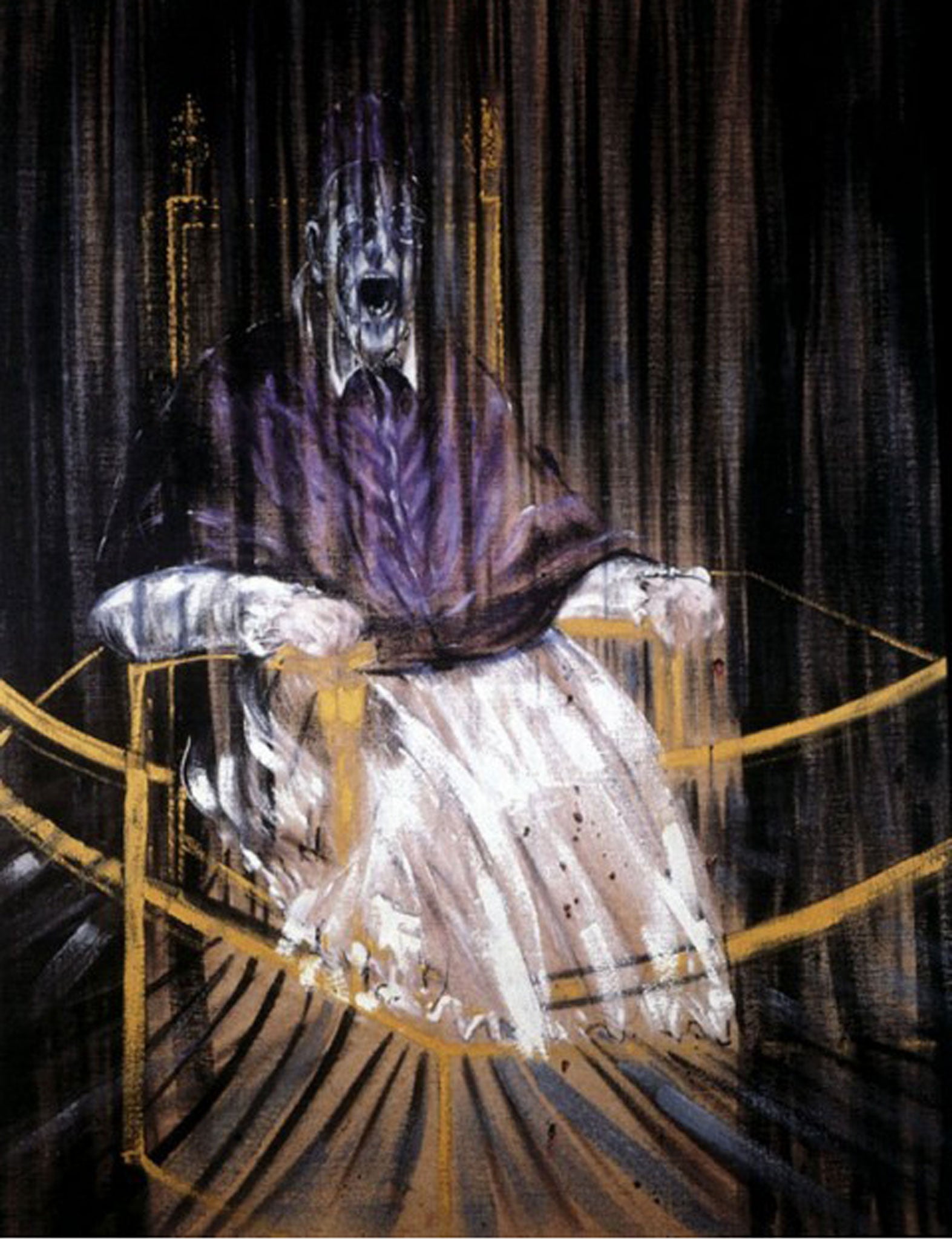
On this, admittedly more difficult and speculative reading, the Pope might be hinting darkly at the difficulties that attend to ascertaining the Church’s trajectory. Do the press releases have an esoteric/exoteric duality? To put it another way, are the statements issuing from (in particular, but not necessarily limited to) the Post-Vatican II Church, susceptible to two readings: one available at the general, public level, the other only available to the few, initiated into the secret purposes at play?[12]


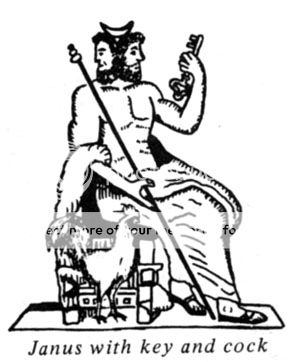
Is the Church currently two-faced, like the Roman god Janus - another time deity?


Tillich, pictured on the Time cover next to a human skull, had inspired the so-called “Death of God Theology.”[13]


The idea of the “death of god,” in this context, can be traced back to the German philosopher Friedrich Nietzsche, who in his Die fröhliche Wissenschaft wrote:[14] “…Gods, too, decompose! God is dead! God remains dead! And we have killed him! How can we console ourselves, the murderers of all murderers?! The holiest and the mightiest thing the world has ever possessed has bled to death under our knives: who will wipe this blood from us? With what water could we clean ourselves? What festivals of atonement, what holy games will we have to invent for ourselves? Is the magnitude of this deed not too great for us? Do we not ourselves have to become gods merely to appear worthy of it? There was never a greater deed - and whoever is born after us will on account of this deed belong to a higher history than all history up to now!”[15]

“‘This thing all things devours: Birds, beasts, trees, flowers; Gnaws iron, bites steel; Grinds hard stones to meal; Slays kings, ruins town, And beats high mountains down.’ Poor Bilbo sat in the dark thinking… His tongue seemed to stick in his mouth; he wanted to shout out: ‘ Give me more time! Give me more time! But all that came out with a sudden squeal was: ‘Time! Time!’”[16]


“[H]is last riddle, delivered when he thinks ‘the time had come to ask something hard and horrible,’ derives from a poem in Old English, the riddle-game, or more precisely the wisdom-testing exchange, between Solomon and Saturn.


“In this, Saturn, who represents heathen knowledge, asks Solomon, ‘What is it that …goes on inexorably, beats at foundations, causes tears of sorrow …into its hands goes hard and soft, small and great?’ The answer given in Solomon and Saturn is, not ‘Time’ as in Bilbo’s desperate and fluky reply, but ‘Old Age’: ‘She fights better than a wolf, she waits longer than a stone, she proves stronger than steel, she bites iron with rust: she does the same to us.’”[17]

"In our solar system, the Law of Octaves is the overall pattern of harmony in the universe expressed as a seven-stepped formula embedded in our solar system. The first seven notes of the musical scale represent our progress through the planets... In our solar system, [the] eighth note is Saturn, the one planet the alchemists considered both the beginning and end, the alpha and the omega of our transformation."[18]


"And now I must tell you its real purpose, which we have managed, with great difficulty, to keep secret from the general public. You would have been given all the facts as you approached Saturn; this is a quick summary to put you into the picture. Full briefing tapes will be dispatched in the next few hours. Everything I am about to tell you has the highest security classification.

"Two years ago, we discovered the first evidence for intelligent life outside the Earth. A slab or monolith of hard, black material, ten feet high, was found buried in the crater Tycho. Here it is. ...

"The most astonishing thing about this object is its antiquity. Geological evidence proves beyond doubt that it is three million years old. It was placed on the Moon, therefore, when our ancestors were primitive ape-men.

"After all these ages, one would naturally assume that it was inert. But soon after lunar sunrise, it emitted an extremely powerful blast of radio energy. We believe that this energy was merely the by-product - the backwash, as it were - of some unknown form of radiation, for at the same time, several of our space probes detected an unusual disturbance crossing the Solar System. We were able to track it with great accuracy. It was aimed precisely at Saturn."[19]

Notes:


[1] Scholar Moshe Idel has continued and extended this line of inquiry with his Saturn's Jews: On the Witches' Sabbat and Sabbateanism, London: Continuum, 2011.

[2] Eric Zafran, “Saturn and the Jews,” Journal of the Warburg and Courtauld Institutes, vol. 42, 1979,p. 16; citing Raymond Klibansky, Erwin Panofsky and Fritz Saxl, Saturn and Melancholy: Studies in the History of Natural Philosophy, Religion and Art, London: Nelson; New York: Basic Books, 1964, pp. 161, n. 115, 132 and 121; Alcabitius, Introductorium maius, MS at Oxford, Bodl. Marsh 663; and J. W. Appelius, Historisch-moralischer Entwurff der Temperamenten, 2nd ed., 1737. St. Augustine speaks of “[s]ome [who] say that [God] is Saturn” and he notes the possibility that this identification results from “the sanctification of the Sabbath; for those men assign that day to Saturn.” Harmony of the Gospels, book 1, chapt. 23, section 30; see Augustine of Hippo, The Harmony of the Gospels, Catholic Primer Reference Series, <http://www.catholicprimer.org/>.

[*] Zafran, op. cit., p. 16; citing Lynn Thorndike, A History of Magic and Experimental Science, New York: Columbia Univ. Press, 1934, vol. 7, pp. 145-6 and Emma Jung and Marie Louise von Franz, The Grail Legend, New York: Putnam; Carl G. Jung Foundation for Analytical Psychology, 1970, pp. 205-6.

[3] “Saturn’s Strange Hexagon,” NASA [got] gov, Mar. 27, 2007, <http://www.nasa.gov/mission_pages/cassini/multimedia/pia09188.html>.)

[4] A.k.a. the “Shield of David,” Magen David or even the Seal of Solomon. It is an alchemical sigil having nothing to do with King David of the Bible. “It was ‘bequeathed’ to rabbinic leaders in the 14th century by the hermeticist King Charles IV of Bohemia, and formally adopted as ‘the Star of David’ in 1898 at the Second Zionist Congress in Switzerland.” Michael Hoffman, Judaism Discovered, Coeur d’Alene, Idaho: Independent History and Research, 2008, p. 784; citing Wolf Gunther Plaut, The Magen David: How the Six-Pointed Star Became an Emblem for the Jewish People, Washington, D.C: B’nai B’rith Books, 1991.

[5] Paul Tillich; quoted by Elisabeth Siftonm, The Serenity Prayer: Faith and Politics in Times of Peace and War, New York: W. W. Norton and Co., 2005, p. 160; archived online at <https://books.google.com/books?id=uiabWkyU7yEC&pg=PA160>.)

[6] Cf. “The god of this age has blinded the minds of unbelievers, so that they cannot see the light of the gospel that displays the glory of Christ, who is the image of God.” The Holy Bible, 2 Corinthians chapter 4, verse 4, New International Version.

[7] Ibid. The Biblical God, Yahweh, is indeed sovereign over linear history. But this is evidently not Tillich’s meaning, since he explicitly espouses a sort of Nietzschean perspectivalism, from which contemporary “situation ethics” proceeds. “Afraid of missing the eternal truth, [some theological systems] identify it with some previous theological work, with traditional concepts and solutions, and try to impose these on a new, different situation. They confuse eternal truth with a temporal expression of this truth. This is evident in European theological orthodoxy, which in America is known as fundamentalism. When fundamentalism is combined with an antitheological bias, as it is, for instance, in its biblicistic-evangelical form, the theological truth of yesterday is defended as an unchangeable message against the theological truth of today and tomorrow. Fundamentalism fails to make contact with the present situation, not because it speaks from beyond every situation, but because it speaks from a situation from the past. It elevates something finite and transitory to infinite and eternal validity. In this respect fundamentalism has demonic traits. It destroys the humble honesty of the search for truth, it splits the conscience of its thoughts adherents, and it makes them fanatical because they are forced to suppress elements of truth of which they are dimly aware.” Paul Tillich, Systematic Theology, vol. 1, Chicago: Univ. of Chicago Press, [1951] 1973, p. 3; archived online at <https://books.google.com/books?id=WIyz0mYxAwkC&pg=PA3>.

[8] Dotty Brown, “Pope Francis Makes Surprise Stop To Bless Sculpture Symbolizing Catholic Unity With Jews,” Forward, Sept. 28, 2015, <http://forward.com/news/321629/pope-francis-makes-surprise-stop-to-bless-sculpture-symbolizing-catholic-an/>.

[9] Jay Michaelson, “Is Pope Francis Backpedaling on Gays?” Daily Beast, Nov. 18, 2014, <http://www.thedailybeast.com/articles/2014/11/19/the-vatican-s-stealth-anti-gay-conference.html?source=dictionary>.

[10] The Holy Bible, 2 Corinthians chapter 6, verse 15, New International Version.

[11] Peter Kosso, Appearance and Reality: An Introduction to the Philosophy of Physics, New York and Oxford [U.K]: Oxford Univ. Press, 1998, pp. 124 and 150.

[12] See Craig Heimbichner, Blood on the Altar: The Secret History of the World’s Most Dangerous Secret Society, Coeur d’Alene, Idaho: Independent History and Research, 2006. For a visual hint, see Francis Bacon, Study after Velázquez’s Portrait of Pope Innocent X, 1953; archived online at <https://en.wikipedia.org/wiki/Study_after_Vel%C3%A1zquez’s_Portrait_of_Pope_Innocent_X>.

[13] According to his widow, Hannah (née Werner-Gottschow), Tillich was also a philanderer who had encouraged his bride to enter into an “open marriage” (i.e., a “marriage” in which - ostensibly, anyway - both partners agree to jettison the mutual promise of fidelity). Hannah wrote: “He had left me often, flirting with other women, leaving each one of the in turn for another at the succeeding dinner party. Hannah Tillich, From Time to Time, New York: Stein and Day, 1973, p. 145; archived online at <https://books.google.com/books?id=Qr0vAQAAIAAJ>.

[14] “The Gay Science,” Chemnitz, Germany: Ernst Schmeitzner; New York: E. Steige, 1882. For more on the “gay science,” see Michael A. Hoffman, “Of Human Alchemy and the Gay Science,” Revisionist Review [weblog], Aug. 4, 2012, <http://revisionistreview.blogspot.com/2012/08/of-human-alchemy-and-gay-science.html>. See also here, here, here and here.

[15] Friedrich Nietzsche, Nietzsche: The Gay Science: With a Prelude in German Rhymes and an Appendix of Songs, Bernard Williams and Josefine Nauckhoff, eds., Cambridge [U.K.]: Cambridge Univ. Press, 2001, p. 120; archived online at <https://books.google.com/books?id=Vf8KETLiKXMC&pg=PA120>.

[16] J. R. R. Tolkien, The Hobbit, reprint ed., New York: Ballantine, 1988, pp. 77-78.

[17] Carl Runyon, “Bilbo’s Riddle-Exchange with Gollum,” n.d., <http://legacy.owensboro.kctcs.edu/crunyon/Tolkien/hobbit/riddle%20exchange.htm>. Saturn - as “Father Time” - does indeed represent old age and senescence.

[18] Dennis William Hauck, The Complete Idiot's Guide to Alchemy, New York: Alpha; Penguin, 2008, p. 125.

[19] Arthur Charles Clarke, 2001: A Space Odyssey, reprint ed., New York: New American Library, 1993, p. 159; archived online at <http://www.angelfire.com/blog2/endovelico/ArthurC.Clark-2001.pdf> and <https://books.google.com/books?id=d967AAAAIAAJ>. Of course, in the movie, Saturn was changed to Jupiter. See Leonard F. Wheat, Kubrick's 2001: A Triple Allegory, Lanham, Md. and London: Scarecrow Press, 2000, p. 32; archived online at <https://books.google.com/books?id=CswtVpuwbEQC>.

Tuesday, September 25, 2012

Going "Postel": The Making of a "Judeo-Christian"

Guillaume Postel was a 16th century mathematician-philosopher, linguist-philologist, and "Chistian Kabbalist"-mystic (cf. M. L. Kuntz, Guillaume Postel, p. ix; & G.E.S., "Postel, Guillaume," Encyclopedia Judaica 13 (1972), p. 932).

He was apparently a language virtuoso, easily acquiring fluency in multiple languages, including, without limitation, Latin, Greek, Arabic, Chaldean, and Hebrew (cf., Ibid., p. 39, et. passim.). "His knowledge of Hebrew and Arabic was rare among his contemporaries, as was his study and use of the Rabbinical, Cabalistic and Islamic literature preserved in these languages." In fact, Postel "attempt[ed] to harmonize Christian, Jewish and Mohammedan thought..." (p. ix) and himself "had prepared a Latin translation of Genesis and of the Midrash on Ruth..." (G[ershom].Sch[olem]., "Zohar," Encyclopedia Judaica, 16 (1972), p. 1214). Moreover, the "book of Kabbalistic magic" (Michael Hoffman, Judaism Discovered, p. 769), "Sefer Yezirah was translated into Latin by...Postel and printed even before the Hebrew edition..." (Supra., "Yezirah, Sefer," p. 787). "In 1548 he published a kabbalistic commentary in Latin translation on the mystical significance of the menorah, and later a Hebrew edition as well. [Postel was among the] authors [who] had many connections in Jewish circles" (G[ershom].Sch[olem]., "Kabbalah," Encyclopedia Judaica, 10 (1972), p. 645).

The Encyclopedia Judaica notes that Postel designated himself "Ish Kefar Sekhanya u-Shemo Eliyyahu Kol-Maskalyah she-Nitgayyer le-Hibbato she Yisrael", that is, "A man of Kefar Sekania, named Elijah Kol- Maskalyah, who converted [to Judaism] out of love for Israel...", commenting that this "suggests that [Postel] had then become some kind of Judeo-Christian..." (op. cit., p. 933).

This mention of "Kefar Sekhanya" recalls a strange Talmudic passage concerning a figure Rabbis euphemistically designate "Jacob the Heretic" ("In several manuscripts his heresy is indicated as Christianity", Ibid.) We read in BT Abodah Zarah 27b: "...'No man should have any dealings [Conversational intercourse...]  with Minim [Christians], nor is it allowed to be healed by them even [in risking] an hour's life. It once happened to Ben Dama the son of R. Ishmael's sister that he was bitten by a serpent and Jacob, a native of Kefar Sekaniah,[A disciple of Jesus] came to heal him but R. Ishmael did not let him; whereupon Ben Dama said, 'My brother R. Ishmael, let him, so that I may be healed by him: I will even cite a verse from the Torah that he is to be permitted'; but he did not manage to complete his saying, when his soul departed and he died. ...  Whereupon R. Ishmael exclaimed, Happy art thou Ben Dama for thou wert pure in body and thy soul likewise left thee in purity; nor hast thou transgressed the words of thy colleagues, who said, He who breaketh through a fence, a serpent shall bite him'? [Eccl. X, 8, applied to those who break through 'legal fences' which serve to safeguard the Torah (V. Ab. I, 1). — ...the ... opinion of R. Johanan is contradicted by this incident which [evidences] that [even] in cases of extreme danger it is forbidden to be attended by a Min!]  — It is different with the teaching of Minim, for it draws, and one [having dealings with them] may be drawn after them. The Master said: 'Nor hast thou transgressed the words of thy colleagues who have said, He who breaketh through a fence, a serpent shall bite him'? But a serpent did indeed sting him! — The bite of the serpent [which is inflicted upon those transgressing the words] of the Rabbis is such as can never be cured.[The fate in the hereafter that meets him who transgresses the words of the wise is more grievous than the sting of a serpent on earth.] Now, what is it that he might have said? ...  — 'He shall live by them,[Lev, XVIII, 5, Ye shall therefore keep my statutes and mine ordinances, which if a man do he shall live by them. 'The Rabbis take these words to mean that God's commandments are to be a means of life and not of destruction to His children. With the exception of three prohibitions — public idolatry, murder, or adultery — all commandments of the Law are therefore in abeyance whenever life is endangered'. Lev. edited by the Chief Rabbi (Dr. J. H. Hertz), p. 175.]  but not die by them.' And R. Ishmael? — This is only meant when in private, but not in public; for it has been taught: R. Ishmael used to say: Whence can we deduce that if they say to one, 'Worship the idol and thou wilt not be killed,' that he may worship it so as not to be killed? because Scripture says, He shall live by them, but not die by them; you might take this to mean even in public, therefore Scripture says, And ye shall not profane my holy name.[Lev. XXII, 32 (Sanh. 74a).]"

The Encyclopedia Judaica calls "Jacob of Kefar Sakhnayya" a "Judeo-Christian disciple of Jesus" (9 (1972), p. 1233). This "Judeo-Christian disciple" is represented as telling the Tannaitic ("repeater" - a "Sage...whose opinions form the Mishnah" - Encyclopedia Talmudica 1 (1969), p. 762) Rabbi Eliezer ben Hurcanus that Jesus claimed that Micah 1:7 taught that it was alright to use money paid to a prostitute for the purpose of building a toilet for a high priest ("...if the hire of a harlot had been consecrated it could be applied to the erection of a privy for the high priest...", Ibid.).

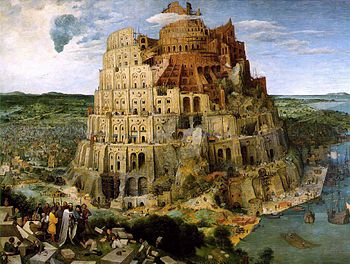
In a sort of reversal of God's judgment on humans after the Tower of Babel, Postel seemed to hold that, in language, was something of a key for "unifying mankind" (p. 35). Moreover, Postel believed "that the Hebrew language [was] the source or parent of all languages." (p. 37). Postel seems to suggest that perhaps Chaldean was more ancient, however, "...he always considered [Hebrew to be the most] sacred and most important of all languages..." (p. 9). "Postel believed that language was a divine gift to Adam, since language enables man to think and to speak and thus distinguishes him from all other animals. ... Since speech is dependent upon hearing and since there was no other man with whom Adam could speak, God in His Wisdom, according to Postel, infused the names of things, as with an inner voice, into Adam's mind. ... Language as an innate idea is a significant aspect of Postel's linguistic theories." (Ibid., pp. 38-39).

Postel espoused a variation of the Pythagorean doctrine of metempsychosis (a "change-in-soul" that is usually construed as a sort of transmigration of a soul from one body to another; reincarnation or "palingenesis," i.e., "to be generated again"), and in this way prefigured the contemporary scene in which people routinely make use of non-Christian concepts such as "karma" and "reincarnation" (see, e.g., Lisa Miller, "We are All Hindus Now"). Postel's concept of reincarnation was modified by his understanding of the Kabbalistic concept of the "Shechinah" (p. 105), which he believed (at least at some point in his life) was embodied in an old mystic woman he called "Mother Johanna" (cf. p. 106, sed etiam passim.). "A marked kabbalistic influence...appears in the career of the humanist Guillaume Postel, who, acclaimed at the court of France for his philological researches in Jerusalem, urged the transfer of the papacy to that city and finally declared himself to be the Shekhinah" (H.N., "Jerusalem: In Other Religions: In Christianity," Encyclopedia Judaica, 9 (1972), p. 1573). Postel also frequently employed the Alchemical language of the "chemical marriage of the Sun and Moon" such that Kuntz classes Postel together with other exponents of "the Gnostic and nature-mystical traditions, such as Reuchlin, Cornelius Agrippa, Paracelsus, Symphorien Champier, John Dee, Robert Fludd, Giordano Bruno, and subsequently, Jacob Boehme, Henry More, F. N. Van Helmont, Emanuel Swedenborg, and William Blake, whose themes resemble those of the Rosicrucians" (Kuntz, p. 106).

Frances Yates has a reference to "...the Abbot Joachim, St. Brigid, Lichtenberg, Paracelsus, Postel, and other illuminati" (The Rosicrucian Enlightenment, p. 48). Curiously: "Stories abound concerning his longevity. Antoine Du Verdier, a contemporary of Postel, states that Postel lived more than one hundred and ten years without any signs of aging. He also states that after one of Postel's voyages, Postel's long grey beard had turned black, even to the roots" (Kuntz, p. 5).

Postel was "...[imprisoned] by the Inquisition at Ripetta (1555-59)..." (Op. cit., 13 (1972), p. 933) and was adjudged "non malus, sed amens" that is, "not guilty, but insane" (Kuntz, p. 3). The Encyclopedia Judaica comments that even though he was "[l]ong derided as a heretic or madman, Postel has emerged as one of the impressive and influential personalities of the Renaissance" (13 (1972), p. 933). This revealing statement seems to imply that the current stream of "Judeo-Christianity" had, as its standard bearer in Century 16, a man whose contemporaries considered to be insane. Perhaps many contemporary "Judeo-Christians" are, like their pioneer, non malus, sed amens: not evil, but crazy.


For further, related information see, especially, Michael Hoffman's:

"Magic and Paganism in the Reign of Elizabeth I" & "The Catholic Church and the Talmud in the Renaissance" (Audio CDs)

Judaism Discovered (From Its Own Texts)

Truth about the Talmud (Weblog)